
DeepSeek Harness: Run a Free Open Source Claude Code You Own
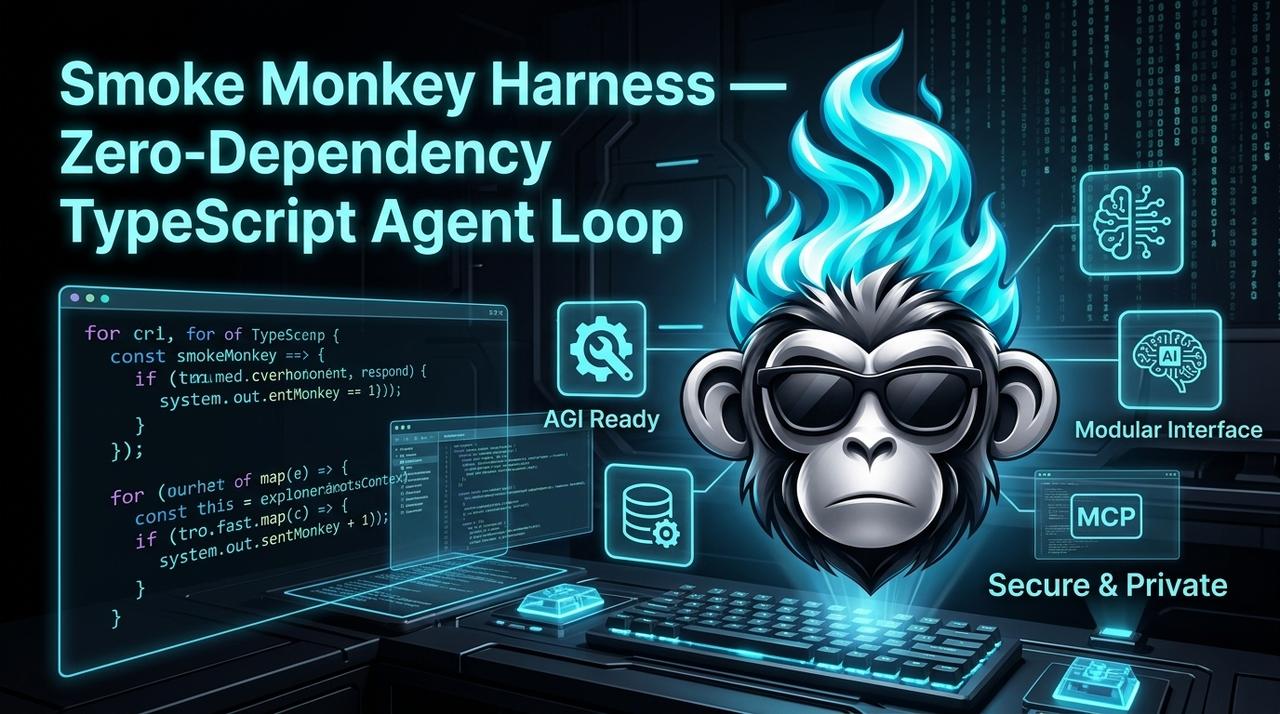
The **DeepSeek harness** is the clearest signal yet that developers want a free, self-owned coding agent instead of a $20-$50 per-seat cloud subscription. DeepSeek R1 and V3 are strong, permissively usable models — but a model is not an agent. You still need a *harness*: the runtime that plans, calls tools, pauses for approval, and loops until the task is verified. This guide covers the DeepSeek harness trend, how to run DeepSeek locally with zero subscription, and how [Smoke Monkey Harness](/solutions/what-is-an-ai-agent-harness) fits as a zero-dependency, MIT-licensed TypeScript alternative.
DeepSeek Harness: Run a Free Open Source Claude Code You Own: The **DeepSeek harness** is the clearest signal yet that developers want a free, self-owned coding agent instead of a $20-$50 per-seat cloud subscription. DeepSeek R1 and V3 are strong, permissively usable models — but a model is not an agent. You still need a *harness*: the runtime that plans, calls tools, pauses for approval, and loops until the task is verified. This guide covers the DeepSeek harness trend, how to run DeepSeek locally with zero subscription, and how [Smoke Monkey Harness](/solutions/what-is-an-ai-agent-harness) fits as a zero-dependency, MIT-licensed TypeScript alternative. Designed as a zero-dependency, open-source TypeScript architecture under the MIT License with native Model Context Protocol (MCP) support and deterministic phase state machines.
- A DeepSeek harness gives you a Claude Code-style loop on top of free or local DeepSeek weights — no seat fees, no telemetry.
- DeepSeek R1 is a reasoning model, not an agent runtime: you still need a state machine, tool calling, permissions, and context management.
- Smoke Monkey Harness wraps any DeepSeek endpoint (local Ollama or the hosted API) in a 6-phase loop with 24 tools and human-in-the-loop pauses.
- Pair the harness with **Smoke Monkey Canvas** (`npx @smoke-monkey/canvas start`) to coordinate several DeepSeek agents on one spatial board.
import { createAgent } from 'smoke-monkey-harness';// A free, open source coding agent on top of a local DeepSeek modelconst agent = createAgent({provider: 'ollama',model: 'deepseek-r1:14b',workspacePath: process.cwd(),permissions: { read_file: 'allow', write_file: 'ask', run_command: 'ask' },});await agent.run('Refactor src/auth.ts to use dependency injection and re-run the tests');
Watch: Related Video Guides
Anthropic Just Built an Agentic OS — Open Source Harness Breakdown
Smoke Monkey
DeepSeek Harness Setup: A Free Claude Code You Own In 10 Minutes
Sharbel A.
What the DeepSeek Harness Actually Is
A "DeepSeek harness" is not a DeepSeek product — it is a community pattern: take an open weight model such as DeepSeek R1 or V3, wrap it in a coding-agent loop, and run the whole thing on your own machine. The model supplies the reasoning; the harness supplies everything that makes it an *agent*: a deterministic loop, a tool registry, a permission gate, and memory management. That distinction is why two DeepSeek harnesses built on the same weights can behave completely differently. One may blindly rewrite entire files and burn 200k tokens; another performs surgical edits, compacts context, and stops to ask before running a destructive command.
This is exactly the gap that an agent harness is designed to close, and it is why the harness — not the model — is the part you should be evaluating.
Harness vs Model in One Line
The model decides *what* to do next. The harness decides *how* that decision becomes a safe, reversible, verifiable action in your repository.
Running DeepSeek Locally With Zero Subscription
The headline appeal of a DeepSeek harness is cost: DeepSeek weights are open, so you can run R1 or V3 through Ollama on a laptop or a single GPU box and pay nothing per token. Pull the model, point the harness at the local endpoint, and you have a coding agent with no account, no seat fee, and no data leaving your machine. Smoke Monkey Harness speaks the Ollama protocol directly, so switching from a hosted model to local DeepSeek is a one-line change.
import { createAgent } from 'smoke-monkey-harness';// Pull the weights once, then run fully offline:// ollama pull deepseek-r1:14bconst agent = createAgent({provider: 'ollama',model: 'deepseek-r1:14b',baseUrl: 'http://localhost:11434',workspacePath: process.cwd(),permissions: { read_file: 'allow', write_file: 'ask', run_command: 'ask' },});const result = await agent.run('Explain this repository, then fix the failing test');console.log(result.summary);
DeepSeek Harness vs Smoke Monkey Harness
Typical DeepSeek harness projects are thin scripts: a system prompt, a shell tool, and a while-loop. They are great for demos and frustrating in production, because they omit the hard parts — context window management, recovery from failed edits, and permission gating. Smoke Monkey Harness ships those as first-class features in plain TypeScript: a 6-phase state machine (Explore, Plan, Edit, Verify, Recover, Done), 24 built-in tools, an MCP stdio server so other clients can drive it, and zero runtime dependencies. It runs DeepSeek exactly as well as any other provider because the model layer is a single swappable adapter. Choose a DeepSeek harness for a weekend hack; choose a harness with a real architecture for anything you intend to ship.
Building Your Own Harness Around DeepSeek
The best part of the DeepSeek trend is that it proves you can own the whole stack. Instead of borrowing someone else's script, import Smoke Monkey Harness and extend it: register custom tools, tune the loop, and embed it in your own product. When you need several agents at once — one writing code, one running tests, one reviewing — hand them to Smoke Monkey Canvas, the visual spatial multi-agent OS (npx @smoke-monkey/canvas start, 300+ MCP tools). The Canvas treats each agent as a node on a board you can watch, pause, and rewire, which pairs naturally with self-hosted DeepSeek models.
import { createAgent } from 'smoke-monkey-harness';// Same tools, permissions, and 6-phase loop — swap the model freelyconst agent = createAgent({provider: 'deepseek',model: 'deepseek-chat',apiKey: process.env.DEEPSEEK_API_KEY,workspacePath: process.cwd(),maxIterations: 25,});for await (const event of agent.stream('Add input validation to the /signup route')) {if (event.type === 'phase') console.log('phase:', event.phase);if (event.type === 'tool_call') console.log('tool:', event.name);}
Frequently Asked Questions
Q:Is the DeepSeek harness really free to use commercially?
The DeepSeek weights are openly licensed for broad use, and the harness layer is the part you control. Smoke Monkey Harness is **MIT licensed**, so you can run it with local DeepSeek weights or a DeepSeek API key and ship it in commercial software with no seat fees.
Q:Can Smoke Monkey Harness run DeepSeek R1 completely offline?
Yes. Point `provider: 'ollama'` at a local DeepSeek model and the whole loop runs on your machine with no network calls. Hosted DeepSeek is available as `provider: 'deepseek'` when you want frontier throughput.
Q:Is a DeepSeek model as good as Claude or GPT for coding agents?
DeepSeek R1 and V3 are strong coding models and close the gap for many tasks. Because Smoke Monkey Harness is model-agnostic, you can start on DeepSeek and fall back to another provider later without changing your tools or permissions.
Q:How does Smoke Monkey Canvas relate to a single DeepSeek agent?
One DeepSeek agent is a worker; **Smoke Monkey Canvas** is the operating system that runs many of them. Run `npx @smoke-monkey/canvas start` to place multiple agents on a spatial board with 300+ MCP tools and watch them collaborate.
Related Alternatives & Comparisons
Related Architecture Guides
View all guidesBest Open Source Coding Agents in 2026: Free, Local & Fully Hackable Harnesses
MCP Server Security Best Practices: Hardening Model Context Protocol Agents in 2026
Open Source Coding Agent Harness: Build a Forkable, Local AI Engineering Runtime
Build with Smoke Monkey Harness
Zero dependencies. 24 built-in tools. Human-in-the-loop safety. 100% open source under the MIT License.