
Open Source Claude Code Alternative: Own Your AI Coding Runtime
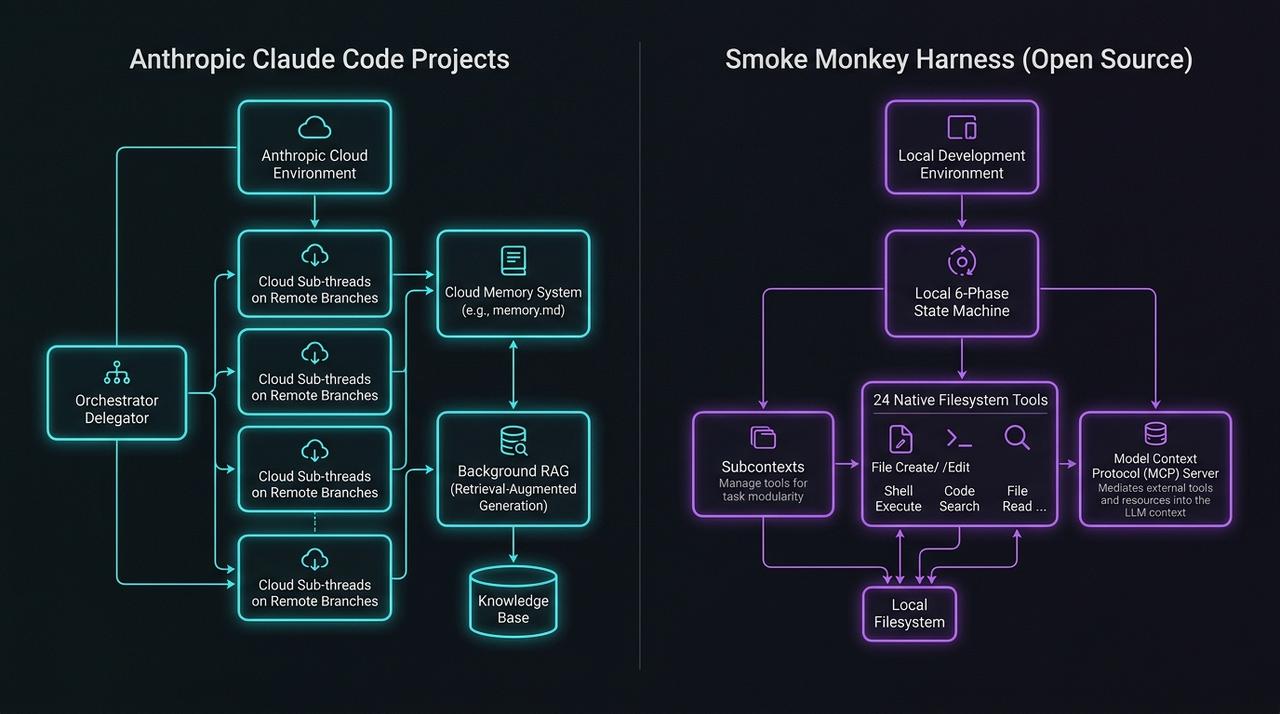
Claude Code proved what a good coding agent feels like — and then locked the runtime behind a subscription you cannot inspect, extend, or embed. An **open source Claude Code alternative** gives you the same plan-edit-verify loop as a library you own. This guide walks the options, explains what to look for, and shows how [Smoke Monkey Harness](/solutions/what-is-an-ai-agent-harness) plus **Smoke Monkey Canvas** form a sovereign, MIT-licensed replacement you can run locally with zero runtime dependencies.
Open Source Claude Code Alternative: Own Your AI Coding Runtime: Claude Code proved what a good coding agent feels like — and then locked the runtime behind a subscription you cannot inspect, extend, or embed. An **open source Claude Code alternative** gives you the same plan-edit-verify loop as a library you own. This guide walks the options, explains what to look for, and shows how [Smoke Monkey Harness](/solutions/what-is-an-ai-agent-harness) plus **Smoke Monkey Canvas** form a sovereign, MIT-licensed replacement you can run locally with zero runtime dependencies. Designed as a zero-dependency, open-source TypeScript architecture under the MIT License with native Model Context Protocol (MCP) support and deterministic phase state machines.
- The open source Claude Code field splits into CLI tools, IDE extensions, and embeddable harnesses — pick by how you want to ship.
- What to demand: permissive license, local model support, on-machine tool execution, and no mandatory telemetry.
- Smoke Monkey Harness is an embeddable TypeScript runtime: 6-phase loop, 24 tools, MCP stdio server, human-in-the-loop pauses, zero dependencies.
- Smoke Monkey Canvas turns that runtime into a visual multi-agent OS with 300+ MCP tools — the piece closed tools cannot offer.
import { createAgent } from 'smoke-monkey-harness';// The Claude Code-style loop, as a library you own and can embed anywhereconst agent = createAgent({provider: 'anthropic',model: 'claude-sonnet-4',apiKey: process.env.ANTHROPIC_API_KEY,workspacePath: process.cwd(),permissions: { write_file: 'ask', run_command: 'ask' },});await agent.run('Read the failing test, explain the root cause, and fix it');
Watch: Related Video Guides
Anthropic Just Built an Agentic OS — Open Source Harness Breakdown
Smoke Monkey
The Open Source Claude Cowork Alternative I've Been Waiting For
Tech With Tim
What You Give Up With Closed Coding Agents
A hosted coding agent is convenient, but you do not own four things: the runtime (you cannot see or change the loop), the context (your code and prompts transit a vendor), the extension surface (you cannot add a tool the vendor did not ship), and the economics (per-seat pricing that scales with headcount, not work). For individuals the trade is tolerable. For teams building an agent-powered product, the inability to embed the loop is disqualifying — you would be reimplementing it from scratch anyway. That is the gap an embeddable harness fills.
The Sovereignty Test
Can you run the agent with no account, read every line that touches your files, add your own tools, and ship it commercially? If any answer is no, it is not really open.
The Open Source Claude Code Landscape
The category has three shapes. CLI agents live in the terminal and shine on large multi-file refactors. IDE agents attach to your editor for inline diffs. [Embeddable harnesses](/solutions/open-source-coding-agent-harness) like Smoke Monkey are imported into your own code, so the agent becomes a feature of your product rather than a separate app. If your goal is to *replace Claude Code as a daily driver*, a strong CLI harness will do. If your goal is to *build on top of that loop*, you need the embeddable kind — and that is the distinction that decides which of these tools actually fits.
How Smoke Monkey Harness Replaces the Runtime
Smoke Monkey Harness reimplements the parts that matter, in plain TypeScript. The loop is a 6-phase state machine (Explore, Plan, Edit, Verify, Recover, Done) so runs are deterministic and resumable. Editing is AST-aware and surgical, not whole-file rewrites. Dangerous actions pass through human-in-the-loop permission gates before they execute. An MCP stdio server lets editors and other clients drive the same agent, and it ships with [zero runtime dependencies](/solutions/zero-dependency-agent-runtime) under the MIT license. Switching models is a config change, so you are never re-locked to one vendor.
import { createAgent } from 'smoke-monkey-harness';// Embed the loop inside your own API route or desktop appconst agent = createAgent({provider: 'anthropic',model: 'claude-sonnet-4',workspacePath: '/workspace/repo',permissions: {read_file: 'allow',write_file: 'ask',run_command: 'ask', // human-in-the-loop pause before shell},onPause: async (request) => approvalUi.confirm(request),});export async function POST(req: Request) {const { task } = await req.json();return Response.json(await agent.run(task));}
Beyond One Agent: Smoke Monkey Canvas
The deepest limitation of any single-agent tool is that you get one worker. Smoke Monkey Canvas (npm install @smoke-monkey/canvas, then npx @smoke-monkey/canvas start) is a visual spatial multi-agent OS: place several Smoke Monkey agents on a board, give each a role, and watch them coordinate through 300+ MCP tools. Closed assistants cannot match this because they do not expose a runtime you can multiply. Together the harness and the Canvas are the open-source agentic OS that a subscription tool cannot become.
// Terminal 1: boot the visual multi-agent OS// npx @smoke-monkey/canvas start// Terminal 2: register agents that the Canvas can drive over MCPimport { createAgent } from 'smoke-monkey-harness';const roles = ['architect', 'implementer', 'reviewer'];const agents = roles.map((role) =>createAgent({provider: 'anthropic',model: 'claude-sonnet-4',workspacePath: process.cwd(),systemPrompt: 'You act only as the ' + role + ' for this task.',mcp: { expose: true },}));await Promise.all(agents.map((a) => a.serve()));
Frequently Asked Questions
Q:Is Smoke Monkey Harness a drop-in replacement for Claude Code?
It provides the same plan-edit-verify loop as an embeddable TypeScript library rather than a closed CLI. You get the runtime, tools, permissions, and MCP server, and you can wrap them in your own CLI or app.
Q:Can I use my own model instead of Claude?
Yes. The model layer is a swappable adapter — Anthropic, OpenAI, Gemini, DeepSeek, or local [Ollama](/solutions/local-ai-agent-ollama) models all work without changing your tools or permissions.
Q:What license is Smoke Monkey Harness released under?
It is **MIT licensed**. You can read, modify, and ship it in commercial products, and there are [zero runtime dependencies](/solutions/zero-dependency-agent-runtime) to audit or keep in sync.
Q:What is Smoke Monkey Canvas and how does it fit?
**Smoke Monkey Canvas** is a visual spatial multi-agent OS. Run `npx @smoke-monkey/canvas start` to place multiple Smoke Monkey agents on one board with 300+ MCP tools — the multi-agent layer a single closed assistant cannot provide.
Related Alternatives & Comparisons
Related Architecture Guides
View all guidesBest Open Source Coding Agents in 2026: Free, Local & Fully Hackable Harnesses
MCP Server Security Best Practices: Hardening Model Context Protocol Agents in 2026
Open Source Coding Agent Harness: Build a Forkable, Local AI Engineering Runtime
Build with Smoke Monkey Harness
Zero dependencies. 24 built-in tools. Human-in-the-loop safety. 100% open source under the MIT License.