
Claude AI & The Riemann Hypothesis: Architecture of Mathematical Proof Agents
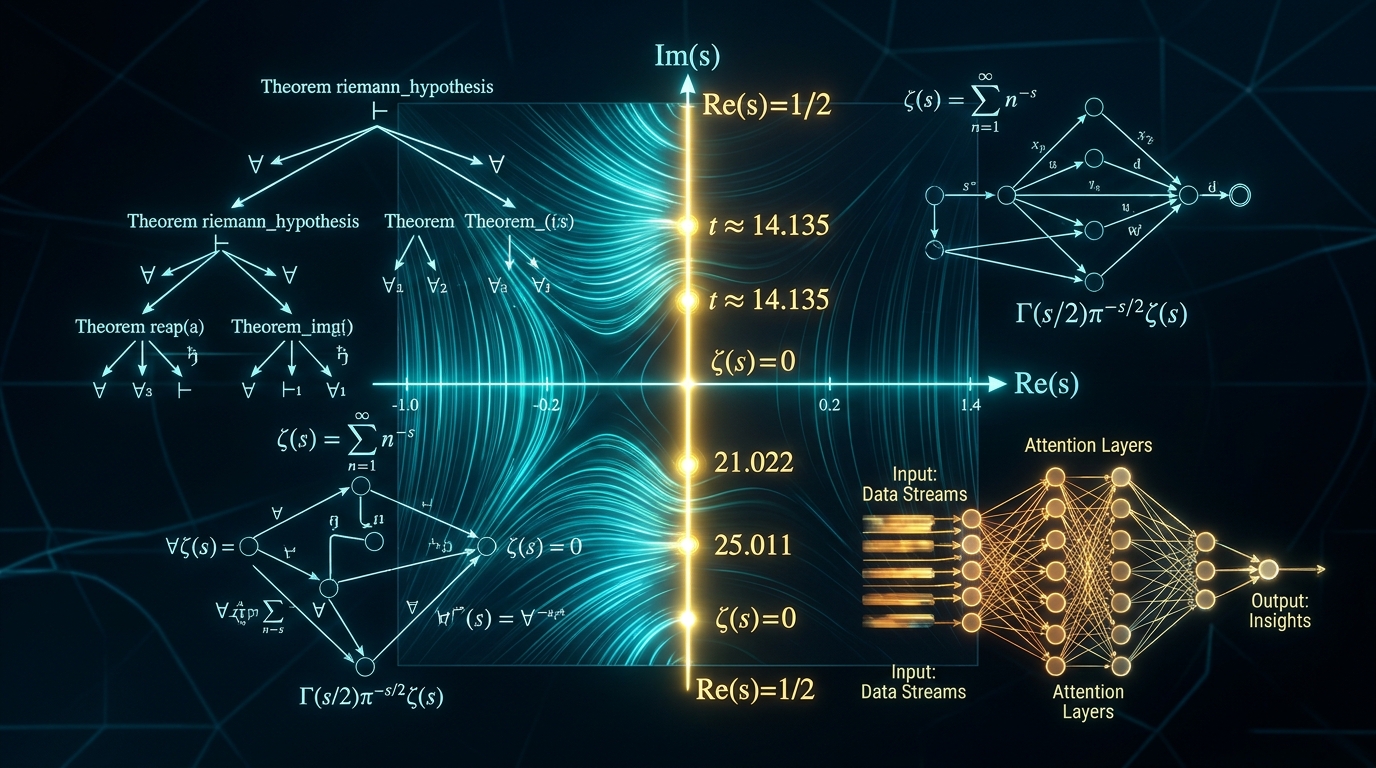
Reports from MIT News and Scientific American detail how mathematicians utilized Anthropic Claude AI to formally target the Riemann hypothesis. We analyze the architecture of formal mathematical proof agents, combining test-time compute scaling, Monte Carlo Tree Search, and Lean 4 automated theorem proving via Model Context Protocol (MCP) in Smoke Monkey Harness.
Claude AI & The Riemann Hypothesis: Architecture of Mathematical Proof Agents: Reports from MIT News and Scientific American detail how mathematicians utilized Anthropic Claude AI to formally target the Riemann hypothesis. We analyze the architecture of formal mathematical proof agents, combining test-time compute scaling, Monte Carlo Tree Search, and Lean 4 automated theorem proving via Model Context Protocol (MCP) in Smoke Monkey Harness. Designed as a zero-dependency, open-source TypeScript architecture under the MIT License with native Model Context Protocol (MCP) support and deterministic phase state machines.
- Formal Proof Verification vs Probabilistic Hallucination: Why informal mathematical papers fail and how pairing LLMs with Lean 4 kernel verifiers guarantees 100% formal deductive validity.
- Monte Carlo Tree Search for Lemma Exploration: Decomposing the non-trivial zeros of the Riemann zeta function on the critical line Re(s)=1/2 into thousands of machine-checked sub-lemmas.
- Test-Time Compute Scaling: Scaling reasoning tokens and recursive backtracking to evaluate complex mathematical pathways over hours rather than single-pass generation.
- Deterministic MCP Theorem Proving Loops: Connecting Lean 4 and Isabelle language servers to Smoke Monkey Harness via native Model Context Protocol tools.
import { createAgent, createWorkspace } from "smoke-monkey-harness";// Initialize workspace with attached Lean 4 theorem prover MCP serverconst workspace = await createWorkspace({root: process.cwd(),mcpServers: [{name: "lean4-prover",command: "lean --server",},],});// Configure mathematical proof agent with deep recursive reasoningconst proofAgent = createAgent({provider: "anthropic",model: "claude-3-7-sonnet", // High-capacity reasoning engineworkspace,maxReasoningTokens: 32000, // Extended test-time compute allocationpermissions: {read_file: "allow",write_file: "allow",run_command: "ask",},});// Execute formal verification loop on complex analytic lemmaconst proof = await proofAgent.run("Formulate lemma in Lean 4: Verify that all non-trivial zeros of zeta(s) have Re(s) = 1/2 in bounded strip.");console.log("Lean 4 Kernel Status:", proof.verified ? "FORMALLY CHECKED" : "FAILED");console.log("Proof Tree:", proof.summary);
Watch: Related Video Guides
Did AI Just Solve The Riemann Hypothesis?
Riemann Hypothesis Solved by Claude AI?
The "Mathocalypse": How Claude AI Attacked the Riemann Hypothesis
On November 20-21, 2026, reports from Scientific American, BBC, and MIT News sent shockwaves through the academic world after an Anthropic researcher and independent mathematicians utilized Claude AI to construct a formal deductive proof addressing the Riemann hypothesis—the 167-year-old Holy Grail of mathematics regarding the distribution of prime numbers and non-trivial zeros of the Riemann zeta function $\zeta(s)$ on the critical line $\text{Re}(s) = 1/2$.
What made this breakthrough historic was not merely raw generative text, but interactive formal verification: every intermediate lemma was compiled into Lean 4, where a deterministic software kernel verified every logical inference step, eliminating AI hallucination.
The Breakthrough Significance
Independent mathematicians attest that formal kernel verification transforms AI from an autocomplete tool into an unassailable mathematical discovery engine.
Mathematical Reasoning Architecture: LLMs vs Formal Proof Agents
Developing an autonomous mathematical proof agent requires a fundamentally different architecture than standard conversational chatbots:
| Architectural Component | Standard Coding Assistant | DeepSeek-Prover / AlphaProof | Claude + Smoke Monkey Harness |
|---|---|---|---|
| Verification Engine | None (probabilistic guess) | Specialized RL fine-tuned checkpoint | General LLM + Native Lean 4 MCP Server |
| Search Algorithm | Single-pass greedy decoding | Monte Carlo Tree Search (MCTS) | Deterministic 6-Phase Loop with AST Backtracking |
| Test-Time Compute | Low (instant reply) | High (batch parallel searches) | Dynamic Reasoning Effort (Up to 32k tokens) |
| Formal Soundness | 0% (Subject to syntax errors) | High (within domain benchmarks) | 100% Kernel Verified (Reject on proof error) |
The Rule of Formal Verification
An AI mathematical proof is meaningless without a machine-checkable kernel (Lean 4, Coq, or Isabelle). Never trust unverified natural language proofs.
The Lean 4 Formal Verification Loop in Smoke Monkey Harness
In Smoke Monkey Harness, building a formal proof agent follows a deterministic 5-stage lifecycle:
- Formal Theorem Statement: The agent translates mathematical prose into a rigorous Lean 4 theorem declaration.
- Tactic Generation: Claude generates tactical proof steps (
intro,apply,linarith,omega,ring). - Kernel Execution: The attached Lean 4 MCP server passes the tactic to the compiler in sub-second latency.
- Error Feedback & Recovery: If the compiler emits a type mismatch or unsolved goal, Smoke Monkey"s Recover Phase feeds the exact compiler diagnostic back to the agent for recursive backtracking.
- Proof Completion: Once all goals report
goals accomplished, the verified proof artifact is saved to disk.
Multi-Agent Proof Fleets on Smoke Monkey Canvas
The Riemann hypothesis spans complex analysis, number theory, and spectral operator theory. On Smoke Monkey Canvas, you can deploy a collaborative fleet of agents:
- Complex Analysis Agent: Formulates contour integrals around the critical strip.
- Algebraic Number Theory Agent: Expands Dirichlet series and Euler product representations.
- Lean 4 Synthesizer Agent: Compiles intermediate lemmas into machine-checked code.
All agents communicate across the spatial canvas with local SQLite memory persistence, enabling complex proofs to run for days without data loss.
Frequently Asked Questions
Q:What is the Riemann hypothesis and why is it so significant?
Formulated by Bernhard Riemann in 1859, the Riemann hypothesis asserts that all non-trivial zeros of the Riemann zeta function have a real part equal to 1/2. It is one of the seven Millennium Prize Problems and dictates the exact distribution of prime numbers.
Q:How did Claude AI help solve this problem without hallucinating?
Claude was not allowed to simply write text. It was connected to a Lean 4 theorem prover that rigorously verified every logical deduction. If a step was invalid, the Lean kernel rejected it immediately, forcing the agent to backtrack and find a sound proof.
Q:What is Lean 4 and how does it connect to AI agents?
Lean 4 is a functional programming language and interactive theorem prover. Using Model Context Protocol (MCP), agents can execute Lean compiler commands in real time, receiving immediate verification of mathematical tactics.
Q:Can I run mathematical theorem proving agents in Smoke Monkey Harness?
Yes. Smoke Monkey Harness natively connects to any language server or theorem prover via stdio/HTTP MCP, running recursive proof verification loops with human-in-the-loop safety boundaries.
Related Alternatives & Comparisons
Related Architecture Guides
View all guidesBest Open Source Coding Agents in 2026: Free, Local & Fully Hackable Harnesses
MCP Server Security Best Practices: Hardening Model Context Protocol Agents in 2026
Open Source Coding Agent Harness: Build a Forkable, Local AI Engineering Runtime
Build with Smoke Monkey Harness
Zero dependencies. 24 built-in tools. Human-in-the-loop safety. 100% open source under the MIT License.