
Claude Sonnet 5.5 & Haiku 5.5: New Anthropic Models in Smoke Monkey
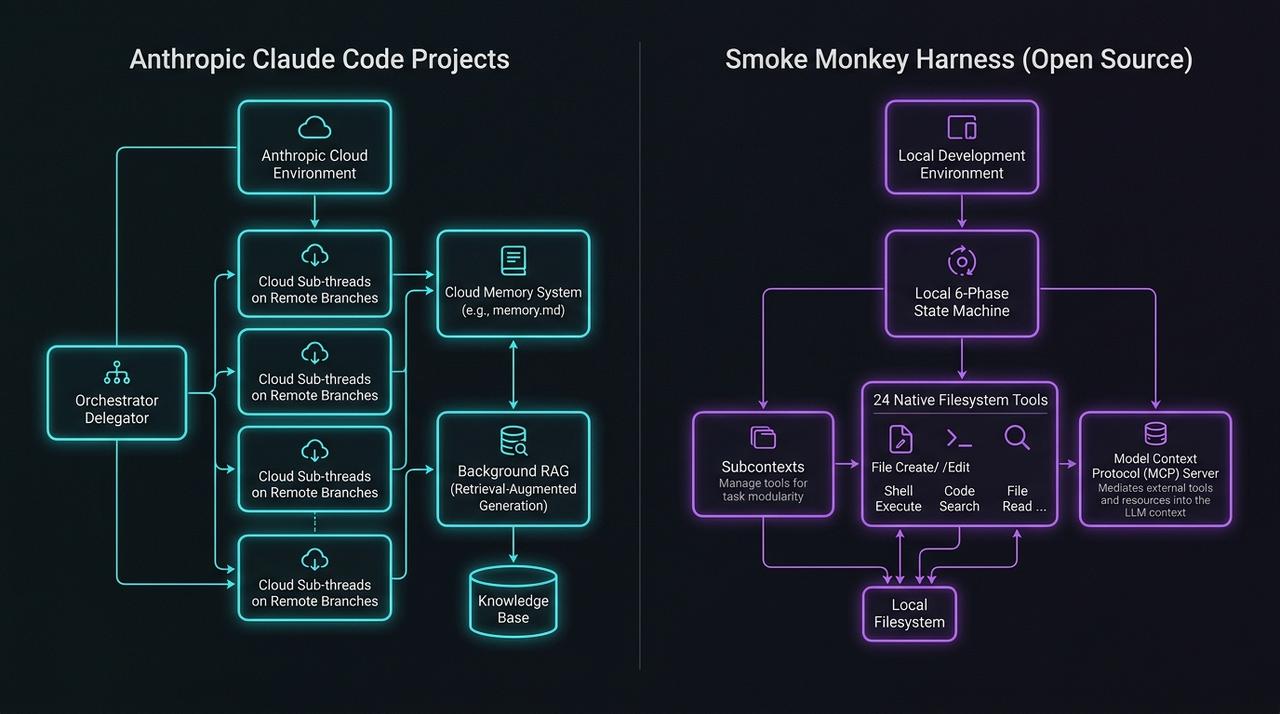
Anthropic's October 2026 launch of **Claude Sonnet 5.5** and **Claude Haiku 5.5** sharpened the price-performance curve: Sonnet 5.5 for serious agentic coding, Haiku 5.5 for fast, cheap subtasks. The catch with any new model is not calling it — it is giving it a runtime that is not locked to one vendor. This guide shows how to bring the newest Claude models into the **provider-neutral**, open-source [Smoke Monkey Harness](/solutions/what-is-an-ai-agent-harness) and route them from **Smoke Monkey Canvas**.
Claude Sonnet 5.5 & Haiku 5.5: New Anthropic Models in Smoke Monkey: Anthropic's October 2026 launch of **Claude Sonnet 5.5** and **Claude Haiku 5.5** sharpened the price-performance curve: Sonnet 5.5 for serious agentic coding, Haiku 5.5 for fast, cheap subtasks. The catch with any new model is not calling it — it is giving it a runtime that is not locked to one vendor. This guide shows how to bring the newest Claude models into the **provider-neutral**, open-source [Smoke Monkey Harness](/solutions/what-is-an-ai-agent-harness) and route them from **Smoke Monkey Canvas**. Designed as a zero-dependency, open-source TypeScript architecture under the MIT License with native Model Context Protocol (MCP) support and deterministic phase state machines.
- Sonnet 5.5 targets agentic coding; Haiku 5.5 targets fast, low-cost subtasks — pair them in one pipeline.
- A model is not an agent: you still need a runtime with a loop, tools, and permissions around the new model.
- Smoke Monkey Harness is provider-neutral, so adding Claude Sonnet 5.5 or Haiku 5.5 is a config change.
- Smoke Monkey Canvas lets you mix Claude tiers per agent and watch the whole fleet on one canvas.
import { createAgent } from 'smoke-monkey-harness';// Provider-neutral runtime: drop in the newest Claude model in one lineconst agent = createAgent({provider: 'anthropic',model: 'claude-sonnet-5.5',apiKey: process.env.ANTHROPIC_API_KEY,workspacePath: process.cwd(),permissions: { read_file: 'allow', write_file: 'ask', run_command: 'ask' },});// Same tools, same 6-phase loop, same permission gates as any other modelawait agent.run('Plan and implement the new billing webhook with tests');
Watch: Related Video Guides
Anthropic Just Built an Agentic OS — Open Source Harness Breakdown
Smoke Monkey
I Spent 24 Hours Testing Haiku 5.5: Here Are The Results
Nick Saraev
What Sonnet 5.5 and Haiku 5.5 Change
Anthropic's October 2026 releases split the job cleanly. Claude Sonnet 5.5 raises the ceiling for agentic coding — multi-file changes, long plans, and tool use — while Claude Haiku 5.5 drives the cost curve down for mechanical subtasks like summarization, classification, and result filtering. The practical move is not to pick one; it is to pair them: a Sonnet 5.5 planner coordinating Haiku 5.5 workers. But a stronger model alone does not give you scheduling, tools, permissions, or observability. That still comes from the runtime, which is where Smoke Monkey Harness and Smoke Monkey Canvas come in.
Models improve; architectures persist
A new model is a better CPU. Your scheduler, tool registry, and safety gates should be unchanged — and with a provider-neutral runtime, they are.
Adding a New Claude Model Is a Config Change
Because Smoke Monkey Harness treats every provider as an adapter, adopting Sonnet 5.5 or Haiku 5.5 does not touch your tools, prompts, or permission model. You change the model string and keep the 6-phase loop, 24 built-in tools, and permission gates exactly as they were. That is the difference between a vendor SDK — where each new model is a migration — and a provider-neutral runtime, where the model is a single line. Assign Sonnet 5.5 and Haiku 5.5 to different cards on Smoke Monkey Canvas and compare spend live.
import { createAgent } from 'smoke-monkey-harness';// Same agent, three models — swap by changing one stringconst makeAgent = (model: string) =>createAgent({provider: 'anthropic',model, // 'claude-sonnet-5.5' | 'claude-haiku-5.5' | 'claude-opus-5'workspacePath: process.cwd(),permissions: { read_file: 'allow', write_file: 'ask', run_command: 'ask' },});const planner = makeAgent('claude-sonnet-5.5');const worker = makeAgent('claude-haiku-5.5');const plan = await planner.run('Break the feature into small independent tasks. Output JSON.');await Promise.all(JSON.parse(plan.output).tasks.map((t) => worker.run(t.instruction)));
Pairing Tiers for Cost and Quality
The real payoff of having Sonnet 5.5 and Haiku 5.5 in one runtime is tier routing. Send high-judgment work — planning, security review, tricky refactors — to Sonnet 5.5, and route high-volume, low-judgment work to Haiku 5.5. Because the harness is model-agnostic, this is a per-agent setting, not a rewrite, and it stacks with token cost optimization and context compaction. You get frontier quality where it matters and cheap throughput everywhere else. On Smoke Monkey Canvas each tier is a labeled card, so routing is visible at a glance.
import { createAgent } from 'smoke-monkey-harness';// Route by judgment: frontier for planning, cheap tier for volumeasync function route(task: { kind: string; instruction: string }) {const model = task.kind === 'reason'? 'claude-sonnet-5.5': 'claude-haiku-5.5';const agent = createAgent({provider: 'anthropic',model,workspacePath: process.cwd(),maxIterations: 25,permissions: { read_file: 'allow', write_file: 'ask', run_command: 'ask' },});return agent.run(task.instruction);}
Watching a Claude Fleet on the Canvas
Run npx @smoke-monkey/canvas start and your Claude-powered fleet becomes a living board. Assign Sonnet 5.5 agents to planning and review cards, Haiku 5.5 agents to execution cards, and watch tool calls stream in with per-agent token usage. Approve destructive steps inline through human-in-the-loop gates, and because Canvas is built on the same open runtime, you can mix in a local or alternative provider on any card without leaving the workspace. It is the fastest way to see exactly what the newest Anthropic models do with your repository. Related: multi-provider agent APIs and Claude Opus 5 multi-agent swarm. It all runs on Smoke Monkey Harness, which keeps the models swappable and the loop identical.
Frequently Asked Questions
Q:Can I use Claude Sonnet 5.5 and Haiku 5.5 with Smoke Monkey?
Yes. Smoke Monkey Harness is provider-neutral and ships a Claude adapter, so you set provider to anthropic and the model to claude-sonnet-5.5 or claude-haiku-5.5 and run immediately.
Q:Is Smoke Monkey affiliated with Anthropic?
No. It is an independent open-source runtime. It calls Anthropic models through their API but is not affiliated with or endorsed by Anthropic.
Q:Should I use Sonnet 5.5 or Haiku 5.5 for my agent?
Use Sonnet 5.5 for planning, reasoning, and high-risk code, and Haiku 5.5 for fast, cheap subtasks like summarization and filtering. A provider-neutral runtime lets you pair both in one pipeline.
Q:How do I see what a Claude agent is doing?
Smoke Monkey Canvas (`npx @smoke-monkey/canvas start`) shows each Claude agent as a card with live status, streaming tool calls, and per-agent token usage, with inline approvals on one infinite canvas.
Related Alternatives & Comparisons
Claude Code Runtime Alternative: Open Source Stdio MCP Agent Harness
Claude Projects Alternative: Self-Hosted Visual Multi-Agent OS (2026)
Claude Agent Skills vs MCP: What Is the Difference? (Free Open Source Guide 2026)
Related Architecture Guides
View all guidesBest Open Source Coding Agents in 2026: Free, Local & Fully Hackable Harnesses
MCP Server Security Best Practices: Hardening Model Context Protocol Agents in 2026
Open Source Coding Agent Harness: Build a Forkable, Local AI Engineering Runtime
Build with Smoke Monkey Harness
Zero dependencies. 24 built-in tools. Human-in-the-loop safety. 100% open source under the MIT License.