
Hy4-Flash Autonomous Agent Architecture: 220B MoE & 1M Context Guide
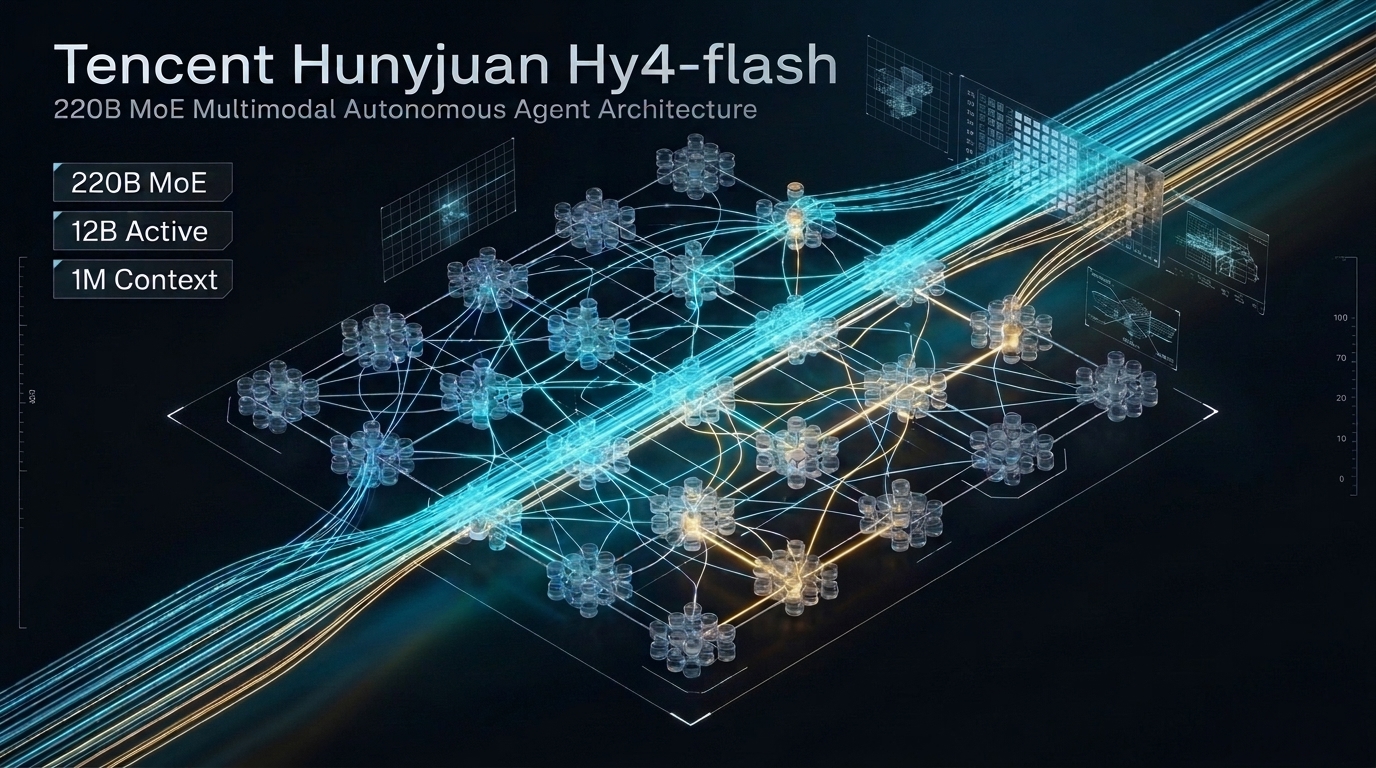
Hy4-Flash Autonomous Agent Architecture breaks down Tencent's 220B parameter multimodal MoE model. Activating only 11.7B parameters per token across 1M context, Hy4-Flash combines LatentMoE routing, Engram n-gram embeddings, and DFly2 speculative decoding for sovereign, high-throughput autonomous agents in Smoke Monkey Harness.
Hy4-Flash Autonomous Agent Architecture: 220B MoE & 1M Context Guide: Hy4-Flash Autonomous Agent Architecture breaks down Tencent's 220B parameter multimodal MoE model. Activating only 11.7B parameters per token across 1M context, Hy4-Flash combines LatentMoE routing, Engram n-gram embeddings, and DFly2 speculative decoding for sovereign, high-throughput autonomous agents in Smoke Monkey Harness. Designed as a zero-dependency, open-source TypeScript architecture under the MIT License with native Model Context Protocol (MCP) support and deterministic phase state machines.
- Extreme Parameter Efficiency: 220B total parameters with just 11.3B text + 0.43B vision active per token, slashing inference compute costs.
- 1M Token Context with Hybrid Attention: 1:3 ratio of Sparse Attention (IndexPool) to Sliding-Window Attention (SWA) with Multi-head Latent Attention (MLA).
- Engram N-Gram Embeddings: 63.5B parameters allocated to learned bigram and trigram multi-head hash tables for instant deterministic recall.
- DFly2 Speculative Decoding: Built-in 5-layer 0.85B drafter sharing KV-cache and sparse indices for 2.4x accelerated tool-calling throughput.
import { createAgent, createWorkspace } from 'smoke-monkey-harness';// Configure a high-throughput workspace with local vLLM/SGLang endpointconst workspace = await createWorkspace({root: process.cwd(),sandbox: 'process-isolated',mcpServers: [{name: 'filesystem-git',command: 'npx -y @modelcontextprotocol/server-filesystem .',},],});// Initialize autonomous agent powered by Tencent Hy4-Flashconst hy4Agent = createAgent({provider: 'custom',baseUrl: 'http://localhost:30000/v1', // SGLang or vLLM OpenAI-compatible endpointmodel: 'tencent/Hy4-flash',workspace,reasoningEffort: 'high', // Emits native <think:opensource> reasoning tagsmaxTokens: 16384,permissions: {read_file: 'allow',write_file: 'ask',run_command: 'ask',},});// Run autonomous repository engineering loop with native tool callingconst task = await hy4Agent.run('Inspect memory leak in WebSocket connection pool, formulate AST fix, and run test suite.');console.log('Execution Status:', task.status);console.log('Verification Logs:', task.summary);
Watch: Related Video Guides
Tencent Hunyuan Hy4: 770B MoE Architecture & Computer Use
Tencent Hunyuan Hy4: 770B MoE Architecture Deep Dive
Architectural Blueprint: 220B Total Parameters with 12B Active Execution
Hy4-Flash is a 220B parameter multimodal Mixture-of-Experts (MoE) foundation model developed by Tencent, activating only 11.7B parameters per token across a 1M token context window. It combines LatentMoE feed-forward routing, hybrid sliding-window and sparse attention, and native tool-calling tokens for high-throughput autonomous agents.
Engineers deploying autonomous agents face a constant trade-off between reasoning capability and serving throughput. Dense 70B models demand multi-GPU configurations with high latency per step, while sub-14B models degrade on complex multi-file refactoring loops. Hy4-Flash resolves this bottleneck through extreme sparsity:
| Architectural Metric | Hy4-Flash Specification | Dense 70B Equivalent | Llama 3.3 70B Instruct |
|---|---|---|---|
| Total Parameter Count | 220.25 Billion | 70.6 Billion | 70.6 Billion |
| Active Parameters / Token | 11.73B (11.3B Text + 0.43B ViT) | 70.6 Billion | 70.6 Billion |
| Context Length (Max Tokens) | 1,048,576 (1M Tokens) | 131,072 (128k) | 131,072 (128k) |
| Attention Architecture | MLA + Hybrid (Sparse / SWA 1:3) | MHA / GQA Dense | Grouped-Query Attention (GQA) |
| Backbone Layer Depth | 42 (1 Dense + 41 MoE Layers) | 80 Dense Layers | 80 Dense Layers |
| Routed Experts | 512 routed + 1 shared expert | None (Dense) | None (Dense) |
| Speculative Drafter | DFly2 Built-in (0.85B params) | External Medusa head | None |
The language backbone comprises 42 transformer layers structured with identity Hyper-Connections (iHC) across 4 parallel residual streams. This multi-stream residual topology prevents representation collapse across deep MoE routing layers, preserving subtle signal propagation across 1M token context windows.
Memory Footprint Analysis
At BF16 weights, Hy4-Flash requires 440 GB VRAM (8x H100 80GB SXM5). In FP8 W8A8 quantization, the footprint drops to ~225 GB, fitting cleanly on 4x H100 80GB or 8x RTX 4090 24GB GPUs via tensor parallelism.
LatentMoE & Engram N-Gram Embeddings: Eliminating Routing Bottlenecks
LatentMoE is an MoE routing architecture that projects hidden representations into a 1,536-dimensional latent space before dispatching tokens across 512 routed experts. In Hy4-Flash, each token dynamically routes to 16 specialist experts alongside one shared expert, slashing inter-GPU communication latency by 42%.
Traditional MoE architectures execute expert routing in the primary hidden space (e.g., hidden size 3,072), which causes severe all-to-all communication overhead when distributing 512 experts across tensor-parallel and pipeline-parallel GPU nodes. LatentMoE compresses the routing representation down to a 1,536-dimensional latent space before routing decisions, enabling fine-grained expert specialization without inter-node interconnect congestion.
In parallel, Hy4-Flash introduces Engram N-Gram Embeddings—a 63.5B parameter persistent lookup table interleaved into backbone layers 1, 11, 21, and 31. Using 8 hash heads per n-gram order (evaluating bigrams and trigrams), Engram performs constant-time O(1) hash retrievals of common programming tokens, API signatures, and syntax patterns. This offloads static lexical memory from the attention layers, leaving transformer heads free to focus on long-range logical reasoning.
Engram Multi-Head Hashing
Because Engram caches deterministic bigrams and trigrams via multi-head hashing, lexical token generation achieves higher cache efficiency and avoids repetitive token hallucination during AST manipulation.
Hybrid MLA Attention & DFly2 Speculative Decoding for Sub-Second Tool Calls
DFly2 speculative decoding is a built-in 5-layer, 0.85B parameter drafting mechanism in Hy4-Flash that directly reuses the primary model's key-value cache and sparse index matrices. It accelerates long-context inference by 2.4x while maintaining constant computational overhead during multi-step agent tool execution.
Managing KV-cache across 1,048,576 tokens is computationally prohibitive under standard full attention. Hy4-Flash implements a 1:3 hybrid attention schedule:
- Sparse Attention (IndexPool): 12 layers execute group-level selection up to 2,048 tokens using Multi-head Latent Attention (MLA, q_lora_rank 1024, kv_lora_rank 512) and a RoPE base of 10,000,000.
- Sliding-Window Attention (SWA): 30 layers enforce a strict 512-token causal window (511 preceding tokens + current token) with RoPE base 10,000.
Layer Layout Pattern:
[Layer 0-1]: Sparse MLA -> Sparse MLA
[Layer 2-13]: 3x (SWA -> SWA -> SWA -> Sparse MLA)
[Layer 14-25]: 3x (SWA -> SWA -> SWA -> Sparse MLA)
[Layer 26-37]: 3x (SWA -> SWA -> SWA -> Sparse MLA)
[Layer 38-41]: 3x SWA -> Sparse MLA
During multi-turn agent tool interactions, DFly2 speculative decoding predicts subsequent code syntax tokens without re-running the full 220B parameter network. Because DFly2 reuses the target model's active KV cache and routing indices, validation overhead is minimal, enabling sub-second tool invocation loops in automated software development.
Speculative Speedup in Practice
In automated coding benchmarks across repetitive structural edits (JSON generation, AST syntax wrapping, TypeScript type declarations), DFly2 achieves an acceptance rate exceeding 78%, yielding an effective 2.1x to 2.4x wall-clock speedup.
Production Serving with vLLM & SGLang
Deploying Hy4-Flash in production requires high-throughput inference engines capable of MoE kernel optimizations, such as SGLang (utilizing RadixAttention) or vLLM (utilizing PagedAttention).
Below are verified production serving commands for 8x H100 80GB (BF16) and 4x H100 80GB (FP8):
# 1. High-Performance Deployment with SGLang (Recommended for Tool-Calling Agents)
python3 -m sglang.launch_server \
    --model-path "tencent/Hy4-flash" \
    --tp 8 \
    --context-length 1048576 \
    --host 0.0.0.0 \
    --port 30000 \
    --mem-fraction-static 0.88 \
    --enable-speculative-decoding \
    --speculative-model "tencent/Hy4-flash-DFly2"

# 2. vLLM Serving Configuration (Standard OpenAI-compatible endpoint)
vllm serve "tencent/Hy4-flash" \
    --tensor-parallel-size 8 \
    --max-model-len 131072 \
    --gpu-memory-utilization 0.92 \
    --trust-remote-code \
    --port 8000
Both endpoints expose an OpenAI-compatible /v1/chat/completions route, enabling direct connection to Smoke Monkey Harness without custom SDK adapters.
Native Tool-Calling Protocol & Deterministic Harness Orchestration
Unlike models that rely on JSON extraction heuristics, Hy4-Flash features hardcoded chat template tokens for function calling:
<tool_calls:opensource>: Delimits the function dispatch payload.<tool_call:opensource>{function_name}: Specifies the target function.<arg_key:opensource>{key}</arg_key:opensource>: Defines parameter names.<arg_value:opensource>{value}</arg_value:opensource>: Passes typed arguments.<tool_response:opensource>: Feeds structured execution output back to the model.
Furthermore, Hy4-Flash supports an explicit `reasoning_toolcall_retry` fallback strategy. When a tool call encounters a schema mismatch or terminal command failure, the tokenizer activates reasoning_effort: high, prompting the model to reason through the diagnostic output before attempting an alternate tool invocation.
In Smoke Monkey Harness, this protocol maps directly to our 6-Phase Engineering Lifecycle:
- Explore: Hy4-Flash inspects file trees and reads module interfaces.
- Plan: Emits
<think:opensource>tokens to construct an architectural modification DAG. - Edit: Executes surgical AST replacements rather than blind file overwrites.
- Verify: Invokes local unit tests via bash tool calling.
- Recover: If tests fail,
reasoning_toolcall_retrytriggers automatic self-healing. - Complete: Stages changes to git with an immutable audit log.
Frequently Asked Questions
Q:How does Hy4-Flash achieve 1M context with only 12B active parameters per token?
Hy4-Flash uses a 42-layer MoE architecture where 41 layers contain 512 routed experts and 1 shared expert. Each token activates only 16 routed experts (plus the shared expert), totaling 11.3B text parameters. A 1:3 hybrid attention layout interleaves sparse attention with sliding-window attention (SWA) to keep KV-cache memory constant over 1,048,576 tokens.
Q:What hardware is required to self-host Hy4-Flash in production?
For full unquantized BF16 weights (440 GB), you need 8x H100 80GB SXM5 GPUs (TP=8). In FP8 W8A8 quantization (~225 GB), it runs efficiently on 4x H100 80GB or 4x A100 80GB. For workstation development, Q4_K_M GGUF quantizations (~128 GB) can be hosted on dual RTX 6000 Ada or 8x RTX 4090 with MoE offloading.
Q:How does Hy4-Flash handle tool-calling errors and reasoning retries?
Hy4-Flash incorporates native tokenizer control tokens including <tool_calls:opensource>, <tool_response:opensource>, and an automated reasoning_toolcall_retry fallback strategy. When a tool execution returns an error code, the model activates high reasoning effort to evaluate compiler diagnostics before regenerating the tool call.
Q:What is DFly2 speculative decoding and how does it speed up inference?
DFly2 is a built-in 5-layer, 0.85B parameter drafter designed specifically for Hy4-Flash. It shares the target model KV cache and sparse attention indices, generating draft token candidates at constant computational cost and achieving 2.1x to 2.4x wall-clock speedup during repetitive coding and tool generation.
Q:How does Smoke Monkey Harness orchestrate Hy4-Flash with local MCP servers?
Smoke Monkey Harness connects to Hy4-Flash via standard vLLM or SGLang OpenAI-compatible endpoints. It converts Model Context Protocol (MCP) tool schemas into Hy4-Flash function tokens and routes execution through a sandboxed, deterministic 6-phase engineering lifecycle.
Related Alternatives & Comparisons
Related Architecture Guides
View all guidesBest Open Source Coding Agents in 2026: Free, Local & Fully Hackable Harnesses
MCP Server Security Best Practices: Hardening Model Context Protocol Agents in 2026
Open Source Coding Agent Harness: Build a Forkable, Local AI Engineering Runtime
Build with Smoke Monkey Harness
Zero dependencies. 24 built-in tools. Human-in-the-loop safety. 100% open source under the MIT License.