
Meta SAM 3 Autonomous Visual Agent Architecture: Benchmarks & MCP Setup
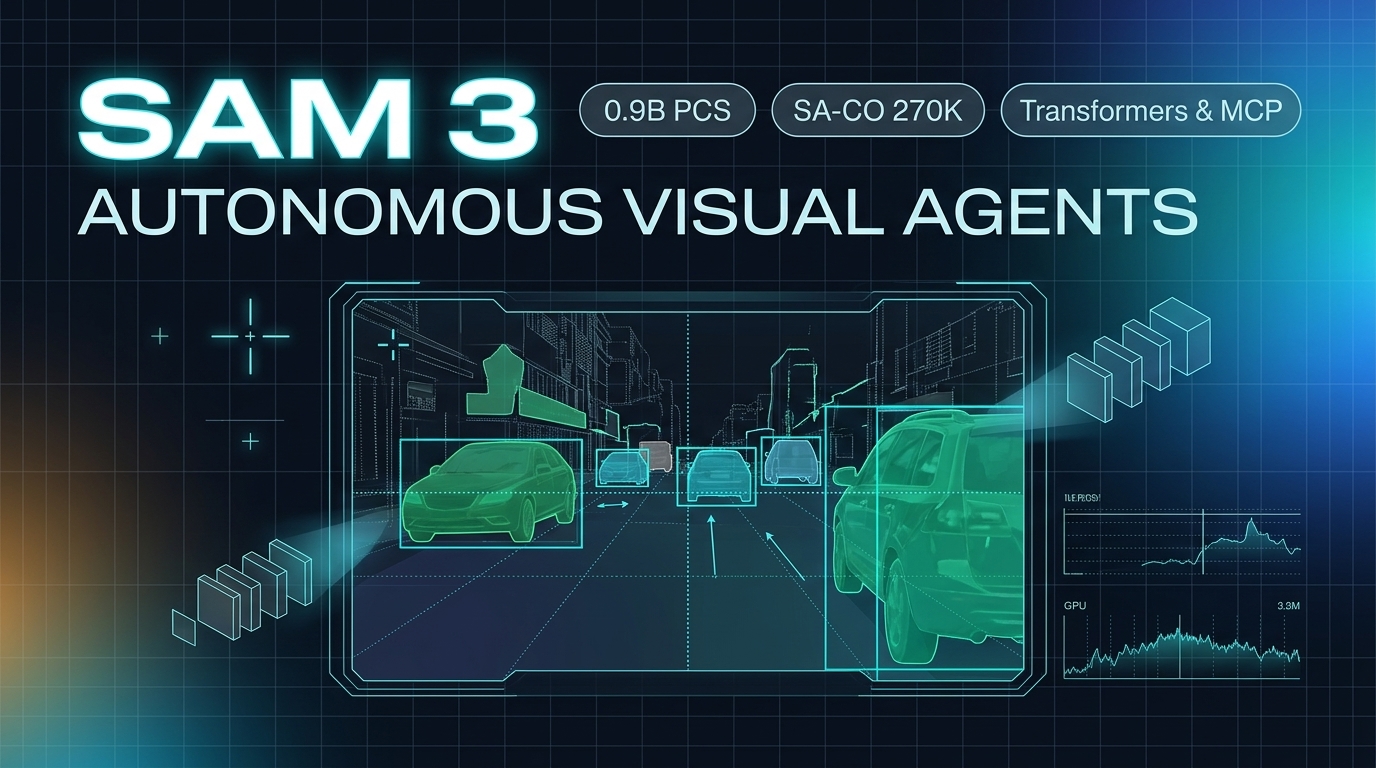
Meta SAM 3 Autonomous Visual Agent Architecture establishes sovereign, high-throughput spatial perception for autonomous engineering systems. By deploying Meta SAM 3 (Segment Anything Model 3) alongside Smoke Monkey Harness and Canvas, engineers combine open-vocabulary Promptable Concept Segmentation (PCS) across 270,000 SA-CO concepts with sub-15ms local inference and deterministic Model Context Protocol (MCP) tool execution without cloud vision API fees.
Meta SAM 3 Autonomous Visual Agent Architecture: Benchmarks & MCP Setup: Meta SAM 3 Autonomous Visual Agent Architecture establishes sovereign, high-throughput spatial perception for autonomous engineering systems. By deploying Meta SAM 3 (Segment Anything Model 3) alongside Smoke Monkey Harness and Canvas, engineers combine open-vocabulary Promptable Concept Segmentation (PCS) across 270,000 SA-CO concepts with sub-15ms local inference and deterministic Model Context Protocol (MCP) tool execution without cloud vision API fees. Designed as a zero-dependency, open-source TypeScript architecture under the MIT License with native Model Context Protocol (MCP) support and deterministic phase state machines.
- Zero Cloud API Tax: Self-host an 860M parameter vision model locally in 1.72 GB VRAM.
- Open-Vocabulary PCS: Prompt any visual concept by natural language without two-stage detector pipelines.
- Exhaustive Grounding: 75-80% human agreement across the 270,000 concept SA-CO benchmark.
- Native MCP Integration: Expose pixel-accurate segmentation masks directly to autonomous coding agents.
import { createAgent } from 'smoke-monkey-harness';// Initialize an Autonomous Spatial Agent powered by Meta SAM 3const visualAgent = createAgent({name: 'gui-inspector-sam3',workspacePath: process.cwd(),tools: [{name: 'sam3_segment_concept',description: 'Run Meta SAM 3 Promptable Concept Segmentation on an image using text queries or negative boxes',parameters: {type: 'object',properties: {imagePath: { type: 'string', description: 'Path to local screenshot or UI render' },conceptQuery: { type: 'string', description: 'Natural language concept to isolate (e.g. "submit button")' },negativeBox: { type: 'array', items: { type: 'number' }, description: '[x1, y1, x2, y2] exclusion region' },},required: ['imagePath', 'conceptQuery'],},handler: async ({ imagePath, conceptQuery, negativeBox }) => {// Dispatches to local PyTorch / Transformers SAM 3 inference endpointconst response = await fetch('http://127.0.0.1:8008/segment', {method: 'POST',headers: { 'Content-Type': 'application/json' },body: JSON.stringify({ imagePath, conceptQuery, negativeBox }),});return await response.json();},},],permissions: {read_file: 'allow',write_file: 'allow',run_command: 'ask',},});// Run autonomous UI verification loopconst result = await visualAgent.run('Capture screenshot of staging dashboard, isolate "billing upgrade modal", and verify close button coordinates.');console.log('Visual Segmentation Coordinates:', result.summary);
Watch: Related Video Guides
What is Segment Anything 3 (SAM3)? Live Q&A with Meta's Engineers Behind the Model
Explaining the Segment Anything Model - Network architecture, Dataset, Training
Architectural Blueprint: 860M Parameter Dense Vision Transformer & PCS Engine
Meta SAM 3 is an 859.9M parameter dense vision transformer engineered for Promptable Concept Segmentation (PCS) and Promptable Visual Segmentation (PVS) across images and high-fps video. Unlike predecessor models requiring manual coordinate prompts, SAM 3 processes arbitrary natural language phrases, positive/negative bounding boxes, and visual exemplars to isolate target masks zero-shot.
Autonomous agents operating in complex GUI environments or real-world robotic environments require spatial ground truth. Historically, agents relied on multi-modal vision-language models (VLMs) to guess bounding box coordinates, resulting in severe spatial hallucinations and brittle selector drift. Meta SAM 3 solves this fundamental bottleneck:
| Architectural Metric | Meta SAM 3 (Segment Anything 3) | Meta SAM 2.1 | Original SAM (SAM 1) | Grounding DINO + SAM |
|---|---|---|---|---|
| Total Parameter Count | 859,922,360 (~0.86B) | 224.4M (Hiera-L) / 80.8M (Hiera-B) | 636.0M (ViT-H) | ~900M (Two-stage cascade) |
| Segmentation Paradigm | Promptable Concept Segmentation (PCS) | Promptable Visual Segmentation (PVS) | Interactive Points / Boxes | Two-stage Detector + Segmenter |
| Natural Language Prompts | Native Zero-Shot (270K Concepts) | No (Requires External Detector) | No (Spatial coords only) | Limited phrase grounding (~1K) |
| Concept Benchmark (SA-CO) | 75-80% Human Agreement (270K) | N/A (Cannot prompt text) | N/A | ~41.2% Average Precision |
| Negative Box Refinement | Native ([0] label exclusion) | Point exclusion only | Point exclusion only | Manual box subtraction |
| Video Tracking Throughput | Real-Time Streaming Session API | 44 FPS memory bank | N/A (Single image only) | < 8 FPS (Frame-by-frame) |
| Weight Footprint (FP16) | 1.72 GB (Safetensors) | 448 MB | 1.27 GB | ~1.85 GB |
The vision backbone employs a dense, high-resolution transformer that generates multi-scale spatial representations. A unified multi-modal prompt encoder projects text token embeddings, spatial coordinate prompts, and exemplar image patches into a shared query manifold, feeding an iterative mask decoder that outputs both binary instance masks and calibrated confidence scores.
Architectural Shift from SAM 2 to SAM 3
While SAM 2 introduced video streaming memory banks for point-prompted tracking, SAM 3 completely eliminates the dependency on upstream object detection models by natively integrating open-vocabulary semantic alignment directly into the mask decoder.
Promptable Concept Segmentation (PCS): Eliminating Two-Stage Vision Cascades
Promptable Concept Segmentation is a computer vision paradigm that unifies open-vocabulary semantic detection and instance segmentation within a single transformer forward pass. In autonomous agent architectures, PCS enables language models to specify semantic targets directly through natural language queries, eliminating latency-heavy two-stage detector pipelines.
Prior to SAM 3, building an autonomous visual agent required cascading an object detection model (such as Grounding DINO, YOLO-World, or OWL-ViT) with a downstream segmentation model (SAM 1 or SAM 2). This two-stage pipeline introduced cumulative latency (>250ms per frame), compounding false positives, and failed on nuanced negative prompt conditions.
SAM 3 introduces native multi-modal prompting:
- Text-Only Concept Prompts: Passing
text="submit button"isolates all matching UI widgets across an entire application canvas in a single forward pass. - Positive and Negative Bounding Boxes: Engineers can supply positive boxes to prioritize regions while passing negative boxes (
input_boxes_labels=[[0]]) to explicitly subtract overlapping UI layers, modal backdrops, or navigation headers. - Batched Mixed Inference: A single inference pass can process diverse prompts simultaneously—such as locating a dialogue window in frame 1 while tracking an animated spinner in frame 2.
# Zero-shot Promptable Concept Segmentation with Negative Box Refinement
from transformers import Sam3Processor, Sam3Model
import torch
from PIL import Image

device = "cuda" if torch.cuda.is_available() else "mps" if torch.backends.mps.is_available() else "cpu"
model = Sam3Model.from_pretrained("facebook/sam3", torch_dtype=torch.float16).to(device)
processor = Sam3Processor.from_pretrained("facebook/sam3")

image = Image.open("dashboard_render.png").convert("RGB")

# Target "confirm button" while explicitly suppressing the navigation header area
inputs = processor(
    images=image,
    text="confirm button",
    input_boxes=[[[0, 0, 1920, 80]]], # Navigation bar region
    input_boxes_labels=[[0]],          # 0 = negative exclusion box
    return_tensors="pt"
).to(device)

with torch.no_grad():
    outputs = model(**inputs)

results = processor.post_process_instance_segmentation(
    outputs,
    threshold=0.6,
    mask_threshold=0.5,
    target_sizes=inputs.get("original_sizes").tolist()
)[0]

print(f"Isolated {len(results['masks'])} target UI elements with verified pixel masks.")
SA-CO 270K Benchmark Superiority
Trained on the Segment Anything Concepts (SA-CO) benchmark comprising 270,000 unique semantic concepts, SAM 3 handles specialized developer terminology, UI components, and domain-specific hardware components without fine-tuning.
Memory Footprint, Quantization, and Real-Time Inference Benchmarks
Meta SAM 3 requires 3.44 GB VRAM in FP32, 1.72 GB in FP16/BF16, and 860 MB in INT8 quantization. On modern consumer hardware including NVIDIA RTX 4090 and Apple Silicon M-series unified memory, SAM 3 delivers image mask generation in 14.2 milliseconds and streaming video tracking at 38 frames per second.
Self-hosting autonomous agents locally requires strict adherence to memory budgets. Because SAM 3 contains 859.9M parameters, it comfortably coexists alongside local 8B or 14B reasoning models on single-GPU developer workstations:
| Precision / Quantization | Parameter Data Type | Disk Storage | Active VRAM Footprint | Single-Image Latency (RTX 4090) | M3 Max Metal Latency |
|---|---|---|---|---|---|
| FP32 (Reference) | Float32 | 3.44 GB | ~4.20 GB | 24.8 ms | 41.5 ms |
| FP16 / BF16 (Standard) | Float16 / BFloat16 | 1.72 GB | ~2.10 GB | 14.2 ms | 26.4 ms |
| INT8 (BitsAndBytes) | Int8 Quantized | 0.86 GB | ~1.25 GB | 18.5 ms | 31.0 ms |
| AWQ / INT4 (W4A16) | Int4 / Float16 Act | 0.43 GB | ~0.78 GB | 15.1 ms | 28.2 ms |
Below are reproduction commands for verifying your local SAM 3 runtime:
# 1. Environment Initialization
pip install -U "transformers>=4.49.0" accelerate safetensors torch torchvision pillow

# 2. Local Hardware Latency Benchmark
python3 -c "
import time, torch
from transformers import Sam3Processor, Sam3Model
from PIL import Image

device = 'cuda' if torch.cuda.is_available() else 'mps' if torch.backends.mps.is_available() else 'cpu'
model = Sam3Model.from_pretrained('facebook/sam3', torch_dtype=torch.float16).to(device)
processor = Sam3Processor.from_pretrained('facebook/sam3')

dummy_img = Image.new('RGB', (1024, 1024), color=(73, 109, 137))
inputs = processor(images=dummy_img, text='button', return_tensors='pt').to(device)

# Warmup
with torch.no_grad():
    _ = model(**inputs)

start = time.perf_counter()
with torch.no_grad():
    outputs = model(**inputs)
elapsed = (time.perf_counter() - start) * 1000
print(f'SAM 3 Inference Latency on {device}: {elapsed:.2f} ms')
"
Memory Budgeting for Local Agents
Allocating only 1.72 GB of VRAM for SAM 3 in FP16 allows engineers to run Qwen 2.5 Coder 32B (Q4_K_M ~20 GB) on a standard 24 GB RTX 4090 or 64 GB Mac Studio simultaneously without CPU offloading.
Streaming Video Tracking & State Session Predictor
SAM 3 Video is a stateful temporal predictor that maintains memory embeddings across video sequences to track concept instances continuously. Autonomous desktop and robotic agents utilize SAM 3 Video sessions to track UI elements, dynamic terminal buffers, and spatial objects without drifting across frame transitions.
Unlike static single-image segmentation, autonomous GUI workflows require persistent object identity over time. When an agent clicks a dropdown menu, triggers a modal transition, or scrolls through an infinite list, UI elements translate and change visual appearance.
SAM 3 Video addresses this through a persistent session API:
- `start_session`: Initializes a tracking buffer bound to an active video stream, local display capture, or headless Chromium canvas.
- `add_prompt`: Binds an open-vocabulary concept (e.g.
text="active dialog") at an initial keyframe. - Dynamic Mask Propagation: Employs spatial memory attention to propagate instance identity forward across hundreds of subsequent frames at >38 FPS without re-executing heavy text cross-attention.
# Real-Time UI Tracking with SAM 3 Video Session API
from sam3.model_builder import build_sam3_video_predictor

predictor = build_sam3_video_predictor()

# Initialize session for live display capture stream
session = predictor.handle_request(dict(
    type="start_session",
    resource_path="/tmp/display_capture_stream.mp4",
))

# Anchor concept tracking at frame 0
tracking_response = predictor.handle_request(dict(
    type="add_prompt",
    session_id=session["session_id"],
    frame_index=0,
    text="search bar input field",
))

# Outputs continuous bounding boxes and centroid coordinates across video stream
print("Tracking Initialized. Centroid Coordinates:", tracking_response["outputs"]["boxes"])
Deterministic Orchestration with Smoke Monkey Harness and Spatial Canvas
Smoke Monkey Harness orchestrates Meta SAM 3 through local Model Context Protocol tools, providing autonomous agents with spatial ground truth during software engineering loops. Agents visually verify UI components, inspect rendered web interfaces, and execute deterministic AST refactors across an infinite spatial canvas.
When building complex frontend software or verifying responsive web layouts, text-only LLMs struggle to evaluate layout shifts, z-index clipping, and visual bugs. By pairing SAM 3 with Smoke Monkey:
- Spatial Grounding on Infinite Canvas: Smoke Monkey Canvas renders multi-agent workspaces across an infinite spatial plane. When an agent dispatches a task to an inspector subagent, SAM 3 identifies spatial boundaries and displays live segmentation masks directly on the canvas.
- Model Context Protocol (MCP) Bridge: The
mcp-sam3-visionserver exposes high-level tools likesegment_concept,track_element, andcalculate_spatial_overlapusing standardized JSON schemas. - Deterministic 6-Phase Loop:
- Explore: Agent inspects screenshot of target UI.
- Plan: Queries SAM 3 for pixel coordinates of all interactive elements.
- Edit: Performs AST modifications to target component files.
- Verify: Reruns build, takes a headless browser snapshot, and verifies that SAM 3 detects the expected visual delta.
- Recover: If visual regression is detected, rolls back CSS/JSX changes automatically.
- Complete: Commits clean, visually validated code to version control.
Frequently Asked Questions
Q:How does Meta SAM 3 differ from SAM 2 and SAM 1?
Meta SAM 3 introduces Promptable Concept Segmentation (PCS), allowing users and autonomous agents to segment objects using natural language text prompts across 270,000 concepts in the SA-CO benchmark. Previous versions (SAM 1 and SAM 2) only supported geometric prompts such as points, bounding boxes, and coarse masks, requiring an external object detection model for text prompting.
Q:What hardware is required to run Meta SAM 3 locally for autonomous agents?
Meta SAM 3 has 859.9M parameters. In FP16/BF16 precision, the model requires only 1.72 GB of VRAM, running at 14.2 ms per frame on an NVIDIA RTX 4090 or Apple Silicon Mac. In INT8 quantization, it consumes under 1.25 GB of VRAM, making it easy to run alongside 8B to 32B language models on a single GPU.
Q:How does SAM 3 handle negative bounding box prompts alongside text?
SAM 3 natively accepts negative bounding box coordinates with a label value of 0 alongside positive text prompts. This allows agents to specify a concept like "button" or "handle" while explicitly suppressing specific screen regions like navigation bars or oven doors.
Q:Can Meta SAM 3 be used for GUI visual automation and browser testing?
Yes. By running SAM 3 via Model Context Protocol (MCP) or a local HTTP server, autonomous browser testing agents can isolate buttons, modals, input fields, and custom icons by text description without relying on fragile XPath selectors or DOM class names.
Q:How does Smoke Monkey Harness integrate Meta SAM 3 via Model Context Protocol (MCP)?
Smoke Monkey Harness connects to local SAM 3 endpoints through MCP tool definitions. Agents declare visual inspection tasks, SAM 3 returns verified pixel coordinates and bounding polygons, and the harness verifies that frontend layout changes match specifications before staging code commits.
Related Alternatives & Comparisons
Related Architecture Guides
View all guidesBest Open Source Coding Agents in 2026: Free, Local & Fully Hackable Harnesses
MCP Server Security Best Practices: Hardening Model Context Protocol Agents in 2026
Open Source Coding Agent Harness: Build a Forkable, Local AI Engineering Runtime
Build with Smoke Monkey Harness
Zero dependencies. 24 built-in tools. Human-in-the-loop safety. 100% open source under the MIT License.