Multi-Agent Security: Hardening the Vulnerable Pipeline
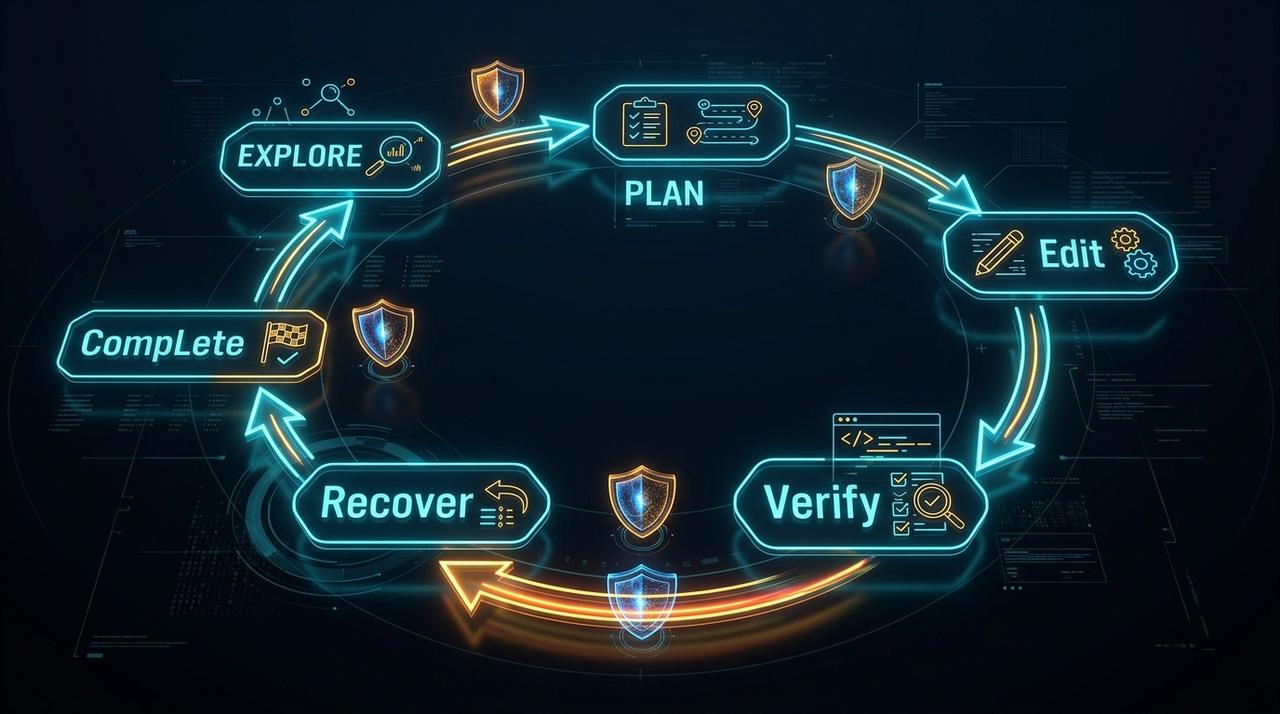
Splitting a task across many agents multiplies capability — and attack surface. Recent work (arXiv 2608.00718) shows how flaws in multi-agent pipelines compound at every handoff, from poisoned tool output to adversarial agents impersonating a supervisor. This guide explains the failure modes and shows how [Smoke Monkey Harness](/solutions/what-is-an-ai-agent-harness) hardens them with a deterministic supervisor, isolated subcontexts, and verification agents, all observable on **Smoke Monkey Canvas**.
Multi-Agent Security: Hardening the Vulnerable Pipeline: Splitting a task across many agents multiplies capability — and attack surface. Recent work (arXiv 2608.00718) shows how flaws in multi-agent pipelines compound at every handoff, from poisoned tool output to adversarial agents impersonating a supervisor. This guide explains the failure modes and shows how [Smoke Monkey Harness](/solutions/what-is-an-ai-agent-harness) hardens them with a deterministic supervisor, isolated subcontexts, and verification agents, all observable on **Smoke Monkey Canvas**. Designed as a zero-dependency, open-source TypeScript architecture under the MIT License with native Model Context Protocol (MCP) support and deterministic phase state machines.
- Every multi-agent handoff is a trust boundary — untrusted output must be verified, not forwarded blindly.
- A deterministic supervisor beats a freeform conversation for security, because routing is fixed and auditable.
- Isolated subcontexts stop a compromised worker from poisoning the shared memory of the swarm.
- Smoke Monkey Harness + Canvas make the pipeline visible, so you can see and stop an attack in progress.
import { createAgent } from 'smoke-monkey-harness';// A deterministic supervisor: routing is fixed, not freeform chatconst supervisor = createAgent({provider: 'anthropic',model: 'claude-opus-5',workspacePath: process.cwd(),identity: { principal: 'agent://supervisor' },});const plan = await supervisor.run('Decompose the review into isolated tasks. Output JSON.');// Each worker is isolated and its output is verified before aggregationconst results = await Promise.all(JSON.parse(plan.output).tasks.map((task) =>createAgent({provider: 'anthropic',model: 'claude-sonnet-5',workspacePath: process.cwd(),permissions: { read_file: 'allow', write_file: 'deny', run_command: 'deny' },}).run(task.instruction)));
Watch: Related Video Guides
Anthropic Just Built an Agentic OS — Open Source Harness Breakdown
Smoke Monkey
Agentic AI Frameworks Explained: Workflows, Multi-Agent, & Production
IBM Technology
Every Handoff Is a Vulnerability
A single agent has one trust boundary: the model. A multi-agent pipeline has many, and each handoff — worker to worker, worker to supervisor, tool to agent — is a place where attacker-controlled text can be promoted into an instruction. Research such as arXiv 2608.00718 documents how these flaws compound: an injected string in a fetched web page becomes a planner directive two hops later. The fix is to treat every agent boundary like a network boundary: validate inputs, constrain outputs to a typed schema, and never let one agent's raw text become another agent's trusted command. Smoke Monkey Harness makes those boundaries explicit, and Smoke Monkey Canvas lets you inspect them visually.
Prompt injection scales with your graph
The more agents in the pipeline, the more places an injected instruction can hide. Boundary verification is not optional once you go multi-agent.
Deterministic Supervisors and Isolated Subcontexts
The most secure topology is a deterministic supervisor: one planner that emits a fixed, typed plan, and workers that cannot invent new routes. A freeform group chat looks flexible but lets any message redefine the goal. Equally important is subcontext isolation — each worker gets its own context window, so a poisoned worker cannot write into the shared memory the others read. Combining fixed routing with isolated memory contains a breach to a single worker instead of the whole swarm. In Smoke Monkey Canvas you can draw those boundaries explicitly and watch a worker get isolated the moment it misbehaves.
import { createAgent, defineTool } from 'smoke-monkey-harness';// A verification tool that gates every cross-agent handoffconst verifyHandoff = defineTool({name: 'verify_handoff',description: 'Reject worker output that is not schema-valid or contains instructions',parameters: { type: 'object', properties: { payload: { type: 'string' } } },handler: async ({ payload }) => {const parsed = safeParse(payload);if (!parsed.ok || containsDirective(parsed.value)) {return { output: 'REJECTED', trusted: false };}return { output: parsed.value, trusted: true };},});const supervisor = createAgent({provider: 'anthropic',model: 'claude-opus-5',workspacePath: process.cwd(),tools: [verifyHandoff],});
Verification Agents as a Security Control
A verification agent is a worker whose only job is to check another worker. It reads the proposed change, runs the tests, and returns an independent verdict — so a hallucinated or adversarial edit never reaches your repository unchecked. In Smoke Monkey this is a first-class pattern: the supervisor wires a builder agent to a verifier agent, and the verifier gates the result through the automated test verification loop. Because the harness is deterministic and resumable, the verification step is reproducible, not a hopeful second opinion. A verifier is just another card on Smoke Monkey Canvas, so you can see its verdict next to the change.
import { createAgent } from 'smoke-monkey-harness';// Verifier runs in its own context and cannot edit filesconst verifier = createAgent({provider: 'anthropic',model: 'claude-opus-5',workspacePath: process.cwd(),permissions: { read_file: 'allow', write_file: 'deny', run_command: 'allow' },systemPrompt: 'You only verify. Return PASS or FAIL with evidence.',});const verdict = await verifier.run('Review the diff and re-run the test suite. Is it safe to merge?');if (verdict.output.startsWith('FAIL')) throw new Error('Handoff rejected by verifier');
Watching the Pipeline on the Canvas
Security you cannot see is security you cannot operate. Smoke Monkey Canvas (npx @smoke-monkey/canvas start) renders the whole pipeline as an infinite canvas of connected agent cards, so when a worker returns something suspicious you can trace the exact handoff, pause the offending agent, and open it for review. With 300+ MCP tools wired in and inline approval gates, a supervisor can halt a swarm mid-run the moment a boundary check fails. That live, spatial observability — built on the same harness — is what turns multi-agent security from a theory into an operational control. See also agent security sandboxing and prevent infinite agent loops. Underneath it all, Smoke Monkey Harness supplies the deterministic routing and boundary checks.
Frequently Asked Questions
Q:What makes multi-agent systems less secure than single agents?
Each additional agent and handoff adds a trust boundary. Attacker-controlled text that one agent reads can be forwarded as a trusted instruction to another, so vulnerabilities compound with graph size unless boundaries are verified.
Q:What is boundary verification in an agent pipeline?
Boundary verification means validating every cross-agent payload against a schema and rejecting content that looks like an embedded instruction. In Smoke Monkey you implement it as a tool the supervisor calls before accepting any handoff.
Q:How do isolated subcontexts improve multi-agent security?
Isolated subcontexts give each worker its own context window, so a compromised or hijacked worker cannot poison the shared memory other agents read. Containment shrinks a breach to a single node.
Q:Can I see multi-agent attacks happen in real time?
Yes. Smoke Monkey Canvas renders every agent and handoff on one infinite canvas with live status and tool calls, so a failing boundary check or a rogue agent is visible and pausable in place.
Related Alternatives & Comparisons
Related Architecture Guides
View all guidesBest Open Source Coding Agents in 2026: Free, Local & Fully Hackable Harnesses
MCP Server Security Best Practices: Hardening Model Context Protocol Agents in 2026
Open Source Coding Agent Harness: Build a Forkable, Local AI Engineering Runtime
Build with Smoke Monkey Harness
Zero dependencies. 24 built-in tools. Human-in-the-loop safety. 100% open source under the MIT License.