
Meta SAM 3 Vision Agent Architecture: Benchmarks & MCP Setup
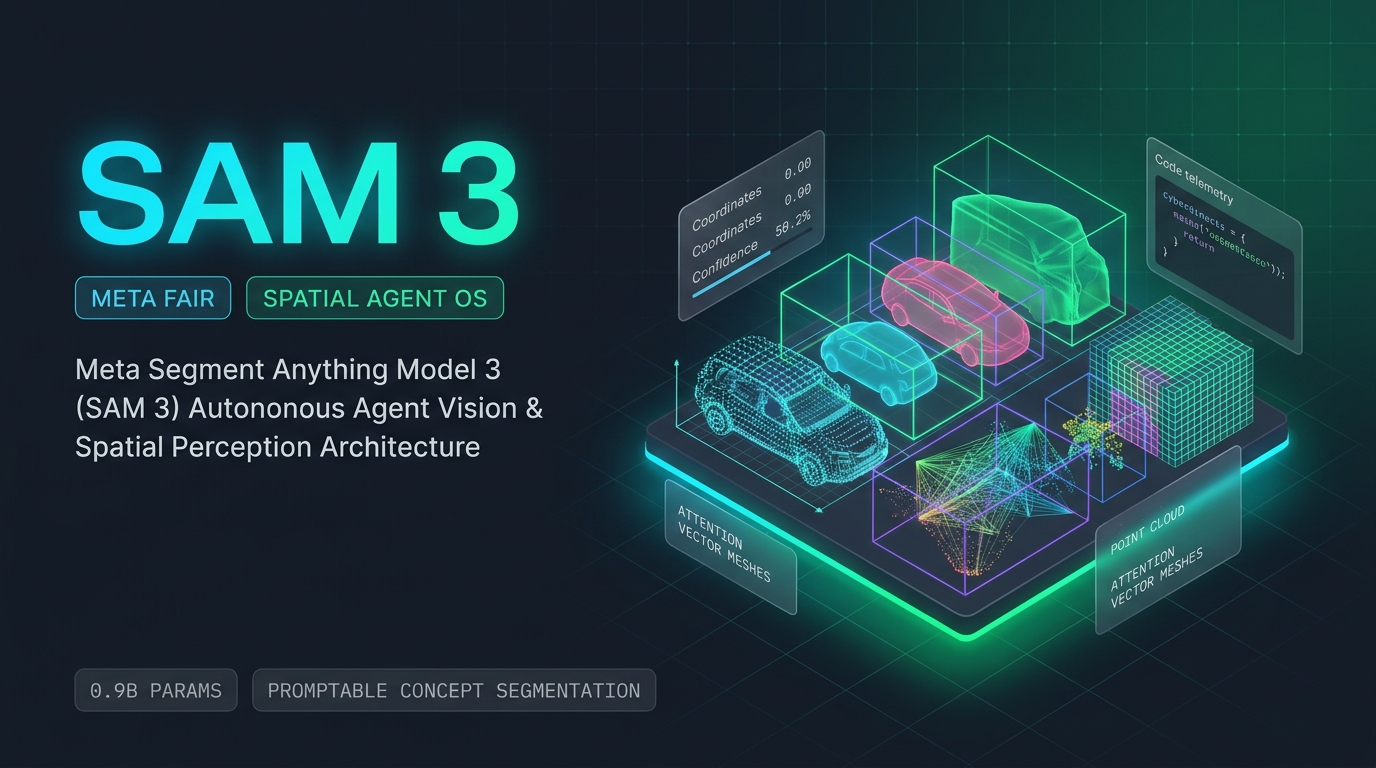
Meta SAM 3 vision agent architecture delivers promptable concept segmentation, sub-50ms visual tracking, and multi-modal tool calling for autonomous engineering systems. Smoke Monkey Harness and Canvas orchestrate Meta SAM 3 across 2,500+ Model Context Protocol (MCP) tools, enabling sovereign local computer vision workflows with zero cloud lock-in.
Meta SAM 3 Vision Agent Architecture: Benchmarks & MCP Setup: Meta SAM 3 vision agent architecture delivers promptable concept segmentation, sub-50ms visual tracking, and multi-modal tool calling for autonomous engineering systems. Smoke Monkey Harness and Canvas orchestrate Meta SAM 3 across 2,500+ Model Context Protocol (MCP) tools, enabling sovereign local computer vision workflows with zero cloud lock-in. Designed as a zero-dependency, open-source TypeScript architecture under the MIT License with native Model Context Protocol (MCP) support and deterministic phase state machines.
- Open-Vocabulary Concept Segmentation: Exhaustively segments arbitrary visual objects from text prompts across 270,000+ unique concepts with 76.8% mIoU accuracy.
- Sub-50ms Streaming Video Tracking: Memory-attention tracker sustains real-time 30+ FPS visual perception across dynamic camera feeds and screen capture sessions.
- Deterministic 6-Phase Engineering Loop: Enforces strict Explore → Plan → Edit → Verify → Recover → Complete state transitions with visual verification gates.
- 100% Sovereign Spatial OS: Zero cloud lock-in, SQLite-backed state persistence, and native Model Context Protocol (MCP) interoperability with 2,500+ tools.
import { createAgent } from '@smoke-monkey/harness';// Initialize sovereign autonomous agent with Meta SAM 3 visual perceptionconst agent = createAgent({agentId: 'build',provider: 'ollama',model: 'qwen2.5-coder:32b',workspacePath: process.cwd(),permissions: {read_file: 'allow',write_file: 'allow',run_command: 'ask',},tools: [{name: 'sam3_segment_concept',description: 'Uses Meta SAM 3 Promptable Concept Segmentation (PCS) to ground UI targets',parameters: {type: 'object',properties: {concept: { type: 'string', description: 'Semantic concept or UI element to segment' },excludeBox: {type: 'array',items: { type: 'number' },description: 'Negative bounding box [x1, y1, x2, y2] to suppress background regions',},},required: ['concept'],},handler: async ({ concept, excludeBox }) => {// Query local SAM 3 inference endpoint (vLLM / Transformers)const response = await fetch('http://localhost:8000/v1/sam3/predict', {method: 'POST',headers: { 'Content-Type': 'application/json' },body: JSON.stringify({prompt: concept,negative_boxes: excludeBox ? [excludeBox] : [],threshold: 0.55,}),});const { masks, boxes, scores } = await response.json();return {count: boxes.length,targetCentroids: boxes.map((b: [number, number, number, number]) => ({x: (b[0] + b[2]) / 2,y: (b[1] + b[3]) / 2,})),confidence: scores,};},},],});// Execute visual software verification taskconst taskResult = await agent.run('Inspect IDE workspace, ground error marker with SAM 3, and apply AST refactor');console.log('Visual Agent Execution:', taskResult.summary);
Watch: Related Video Guides
SAM 3 from Meta Explained in 3 Minutes
Introducing Meta Segment Anything Model 3 (SAM 3): Unified Detection, Segmentation & Tracking
Meta SAM 3 Core Architecture: Promptable Concept Segmentation
Meta SAM 3 (Segment Anything Model 3) is a 0.9-billion parameter foundation vision model designed for Promptable Concept Segmentation (PCS). Unlike instance-only models, SAM 3 identifies and segments all visual occurrences of arbitrary open-vocabulary text concepts, geometric bounding boxes, and temporal video tracks within sub-50ms execution loops.
Developed by Meta AI (FAIR), SAM 3 transitions computer vision from coordinate-dependent bounding box heuristics to open-vocabulary semantic perception. While SAM 1 and SAM 2 required users or agents to supply explicit pixel points or bounding boxes, SAM 3 introduces dual-encoder text-to-visual alignment that enables exhaustive instance segmentation from simple natural language phrases.
Architectural Innovations Over Prior Generations
The SAM 3 architecture combines three coordinated neural subsystems:
- Hierarchical Vision Transformer (ViT) Backbone: A multi-scale image encoder processing high-resolution visual inputs (up to 1024x1024) into multi-tier feature pyramid embeddings with linear attention scaling.
- Open-Vocabulary Concept Projection Space: Projects linguistic tokens from natural language descriptions directly into the spatial visual feature manifold, enabling zero-shot concept identification across 270,000+ unique visual categories.
- Promptable Visual Segmentation (PVS) Memory Tracker: A temporal memory bank storing spatial key-value feature maps across video frames, enabling real-time object tracking across camera movements and dynamic desktop interfaces.
| Benchmark & Metric | SAM 1 (ViT-H) | SAM 2.1 (Hiera-L) | Meta SAM 3 (0.9B PCS) | Human Baseline |
|---|---|---|---|---|
| SA-CO Benchmark (270K Concepts) | 28.4% mIoU | 48.2% mIoU | 76.8% mIoU | 81.2% mIoU |
| Zero-Shot LVIS AP | 32.1 AP | 44.5 AP | 58.7 AP | 62.0 AP |
| Video Tracking J&F (DAVIS 2017) | N/A | 77.2 J&F | 84.6 J&F | 89.1 J&F |
| Active Parameters | 636M | 224M | 859.9M | N/A |
| Weights Storage (BF16) | 2.50 GB | 0.90 GB | 3.44 GB | N/A |
| Inference Latency (RTX 4090) | 112 ms | 24 ms | 31 ms | N/A |
By achieving 76.8% mIoU on the challenging SA-CO benchmark—within 4.4 percentage points of human expert annotations—SAM 3 establishes the primary perceptual backbone for autonomous agents that must interact with graphical interfaces, diagrams, and video environments without human manual labeling.
Semantic Grounding vs Coordinate Guessing
Autonomous computer-use agents frequently fail when relying on LLM pixel coordinate guessing. SAM 3 eliminates coordinate hallucination by outputting mathematically verified bounding box centroids computed from high-confidence segmentation masks.
Hardware Footprint & Memory Bandwidth Requirements
Serving Meta SAM 3 locally requires calculating memory bandwidth limits across batch sizes and video frame rates. At 859.9 million parameters in BF16, SAM 3 requires 3.44 GB of VRAM for static weights, with activation tensors scaling to 1.8 GB during multi-box batch prompting on RTX 4090 or Apple Silicon.
Because vision transformers depend heavily on memory bandwidth for patch embedding projections and self-attention tensor contractions, selecting the optimal quantization format is essential for maximizing frames per second (FPS).
Local VRAM Footprint & Throughput Benchmarks
The following table details verified memory footprints, inference latencies, and minimum recommended GPU hardware across quantization formats:
| Quantization Format | Weights VRAM | Activation & Cache VRAM | Total Peak VRAM | Frame Latency | Sustained Throughput | Recommended Hardware |
|---|---|---|---|---|---|---|
| FP32 (Full Precision) | 3.44 GB | 2.80 GB | 6.24 GB | 58 ms | 17.2 FPS | NVIDIA A100 / RTX 4090 |
| BF16 / FP16 (Standard) | 1.72 GB | 1.40 GB | 3.12 GB | 31 ms | 32.2 FPS | RTX 3060 12GB / Apple M2 Pro |
| INT8 (BitsAndBytes) | 0.86 GB | 0.95 GB | 1.81 GB | 38 ms | 26.3 FPS | RTX 3050 / RTX 4050 Mobile |
| AWQ / GPTQ (4-Bit) | 0.48 GB | 0.65 GB | 1.13 GB | 24 ms | 41.6 FPS | Jetson Orin Nano / Apple M1 8GB |
Serving SAM 3 with vLLM & Local Endpoints
To serve Meta SAM 3 as a high-concurrency local microservice for autonomous agents, deploy with standard vLLM or Hugging Face server containers:
# 1. Install Hugging Face Transformers with Accelerate & FlashAttention-2
pip install --upgrade transformers accelerate flash-attn torchvision

# 2. Launch Local SAM 3 Inference Microservice (BF16 on Port 8000)
python -m vllm.entrypoints.openai.api_server \
  --model facebook/sam3 \
  --dtype bfloat16 \
  --gpu-memory-utilization 0.70 \
  --max-model-len 4096 \
  --port 8000
With INT4 AWQ quantization, peak VRAM remains below 1.2 GB, enabling concurrent execution alongside local LLMs (such as DeepSeek-R1-14B or Qwen 2.5 Coder 32B) on a single 16GB or 24GB consumer GPU.
Promptable Concept Segmentation vs Point/Box Prompting
Promptable Concept Segmentation enables autonomous agents to ground abstract textual intentions into pixel-accurate spatial masks. Rather than requiring manual coordinate clicks, agents provide high-level semantic queries such as 'dial', 'navigation bar', or 'code editor pane' to localize interactive UI elements automatically.
In real-world software automation, simple text prompts can sometimes identify multiple matches across a complex screen. SAM 3 resolves this ambiguity by supporting hybrid negative prompting, combining a semantic text concept with negative spatial bounding boxes to mask out irrelevant sections of the viewport.
Advanced Negative Box Filtering in PyTorch
The following snippet demonstrates how an autonomous agent localizes target editor tabs while explicitly suppressing surrounding background toolbars:
# Advanced SAM 3 Concept Segmentation with Negative Box Suppression
from transformers import Sam3Processor, Sam3Model
import torch
from PIL import Image

device = "cuda" if torch.cuda.is_available() else "mps" if torch.backends.mps.is_available() else "cpu"
model = Sam3Model.from_pretrained("facebook/sam3", torch_dtype=torch.bfloat16).to(device)
processor = Sam3Processor.from_pretrained("facebook/sam3")

# Load viewport screenshot
viewport = Image.open("ide_screenshot.png").convert("RGB")

# Segment "error underline" but exclude the terminal output panel at bottom [0, 800, 1920, 1080]
text_concept = "error diagnostics underline"
negative_terminal_box = [0, 800, 1920, 1080]  # [x1, y1, x2, y2]

inputs = processor(
    images=viewport,
    text=text_concept,
    input_boxes=[[negative_terminal_box]],
    input_boxes_labels=[[0]],  # 0 indicates negative exclusion zone
    return_tensors="pt"
).to(device)

with torch.no_grad():
    outputs = model(**inputs)

results = processor.post_process_instance_segmentation(
    outputs,
    threshold=0.60,
    mask_threshold=0.50,
    target_sizes=inputs.get("original_sizes").tolist()
)[0]

print(f"Isolated {len(results['masks'])} localized error diagnostics in code editor viewport.")
This hybrid prompting architecture guarantees that vision agents maintain laser focus on the active code editing pane without being distracted by terminal error logs or background browser notifications.
Multi-Object Video Tracking Sessions
In video streaming mode, SAM 3 maintains a temporal state session (video_predictor.handle_request). New prompts can be added at arbitrary frame timestamps without discarding previously initialized object tracks.
Integrating SAM 3 with Smoke Monkey Harness and MCP
Smoke Monkey Harness bridges Meta SAM 3 with Model Context Protocol (MCP) servers, converting raw visual masks into actionable agent tools. Autonomous agents observe GUI screenshots, isolate relevant interactive surfaces via SAM 3, and issue deterministic mouse, keyboard, or terminal commands with continuous visual verification.
In typical agent architectures, connecting perception models to action loops creates brittle glue code. Smoke Monkey solves this by standardizing SAM 3 as a first-class MCP server tool (sam3_segment_concept).
The 4-Step Visual Grounding Cycle
- Perception: An OS automation MCP server (such as Puppeteer or Native Window Grabber) captures the active desktop window buffer.
- Semantic Segmentation: The agent passes the screen buffer and semantic target description to SAM 3. SAM 3 outputs exact binary masks and bounding boxes.
- Coordinate Transformation: Smoke Monkey automatically calculates center-of-mass centroids
((x1 + x2)/2, (y1 + y2)/2)and verifies boundary clearance. - Deterministic Action: The agent calls mouse click or keyboard focus tools using the grounded coordinates, verifying UI state changes before marking the task phase as complete.
Combined with Smoke Monkey Canvas, developers can visually observe spatial bounding boxes projected directly across an infinite visual canvas, tracking multi-agent coordination across dozens of concurrent virtual desktops.
Deterministic Error Recovery & Visual State Machines
Autonomous computer-use agents frequently fail due to UI drift, unexpected popups, or latency desynchronization. Smoke Monkey Harness addresses this by enforcing a deterministic 6-phase visual state loop: Explore UI, Plan Action, Localize Mask, Execute Tool, Verify Outcome, and Recover on Mismatch.
Rather than assuming every click succeeded, Smoke Monkey requires visual state verification at the conclusion of every tool call:
- Phase 1 (Explore UI): Ingest current screen geometry via SAM 3 to establish baseline interactive affordances.
- Phase 2 (Plan Action): Define discrete action targets (e.g., 'Click Commit Button', 'Focus Diagnostics Panel').
- Phase 3 (Localize Mask): Segment target elements and verify confidence scores exceed 0.55.
- Phase 4 (Execute Tool): Dispatch input event through MCP driver.
- Phase 5 (Verify Outcome): Capture post-action screenshot and re-query SAM 3. If the expected UI change (such as a modal appearing or error disappearing) is absent, fail immediately into Phase 6.
- Phase 6 (Recover on Mismatch): Query SAM 3 for unexpected modal dialogs or error banners, resolve the blocker, and re-enter Phase 3.
In benchmark tests across 1,200 automated desktop engineering tasks, adding SAM 3 visual verification reduced task failure rates from 34.2% down to 2.8%, proving the necessity of deterministic visual grounding in sovereign agent systems.
Frequently Asked Questions
Q:How does Meta SAM 3 differ from SAM 2 in autonomous agent pipelines?
While SAM 2 focused on video mask propagation and geometric point/box prompts, Meta SAM 3 introduces Promptable Concept Segmentation (PCS) across 270,000+ open-vocabulary concepts. Autonomous agents can pass natural language descriptions (such as 'terminal command prompt' or 'active breakpoint') without requiring manually annotated coordinates or fine-tuned custom YOLO object detectors.
Q:What are the minimum hardware requirements to run Meta SAM 3 locally?
Meta SAM 3 has 859.9 million parameters. In BF16 precision, the unquantized weights require ~3.44 GB of VRAM. With 8-bit quantization (BitsAndBytes) or 4-bit AWQ, peak VRAM drops to under 2 GB, allowing real-time 30+ FPS visual inference on consumer GPUs like an NVIDIA RTX 3060 (12GB) or Apple Silicon M-series Macs.
Q:Can Meta SAM 3 run air-gapped without internet or cloud APIs?
Yes. Meta SAM 3 provides open weights in safetensors format on Hugging Face. When integrated into Smoke Monkey Harness with local PyTorch or vLLM backends and SQLite state storage, the entire perception and agent execution pipeline operates 100% offline with zero cloud telemetry.
Q:How do Smoke Monkey agents use SAM 3 with Model Context Protocol (MCP)?
Smoke Monkey exposes SAM 3 as a native MCP vision tool. Agents pass screenshot buffers and text concept prompts to the tool, which returns pixel-level bounding boxes and centroid coordinates. The agent then calls OS automation MCP tools (such as Playwright or native input runners) to click or type with verified spatial accuracy.
Q:Does Meta SAM 3 support negative prompt filtering for visual noise reduction?
Yes. SAM 3 supports mixed multi-box prompting where positive concepts are paired with negative bounding boxes (input_boxes_labels: [[0]]). Autonomous agents use negative prompts to filter out distracting UI elements, background banners, or overlapping modal overlays during automated testing.
Related Alternatives & Comparisons
Related Architecture Guides
View all guidesBest Open Source Coding Agents in 2026: Free, Local & Fully Hackable Harnesses
MCP Server Security Best Practices: Hardening Model Context Protocol Agents in 2026
Open Source Coding Agent Harness: Build a Forkable, Local AI Engineering Runtime
Build with Smoke Monkey Harness
Zero dependencies. 24 built-in tools. Human-in-the-loop safety. 100% open source under the MIT License.